Creating a new hamlet in London’s greenbelt

How to create a new hamlet on London's Greenbelt

Architect and Design Team Leader – Douglas and King Architects
Quantity Surveyor – Andrew Morton Associates
Planning Consultant – Countrywide
Structural Engineer – Conisbee
MandE – Mendick Waring
Main Contractor – See Building Contractors

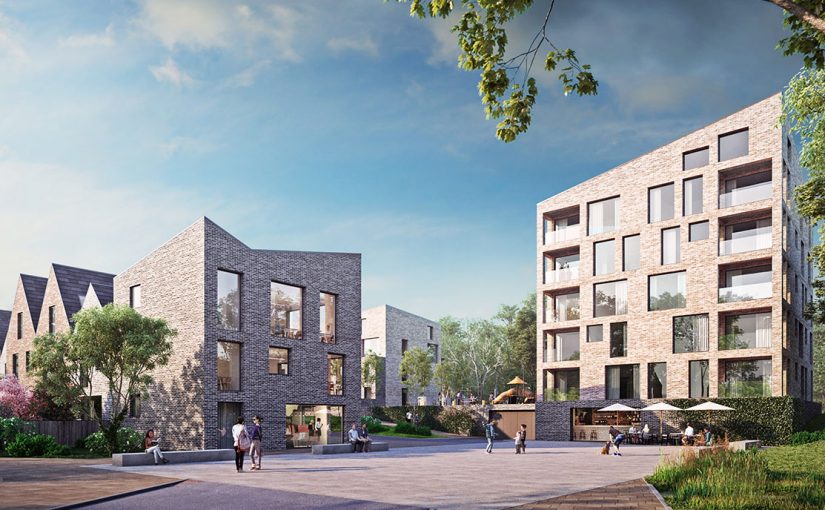
HVF Goffs Oak creates of 10 contemporary family homes on a green belt site in Hertfordshire.  Site works commenced in January 2021 with Design and Project Management services led by the Architect. The project is being delivered with Offsite MMC Technology and has been led from inception through planning, detailed design and tendering stages by the Architect. HVF Goffs Oak is nearing completion on site.

The layout of the site has been planned with place-making at its core to encourage a sense of belonging, and to create a safe, social, friendly, shared environment.  At Douglas and King we have a history of delivering residential schemes on small sites with the aim of creating healthy communities through low impact developments.

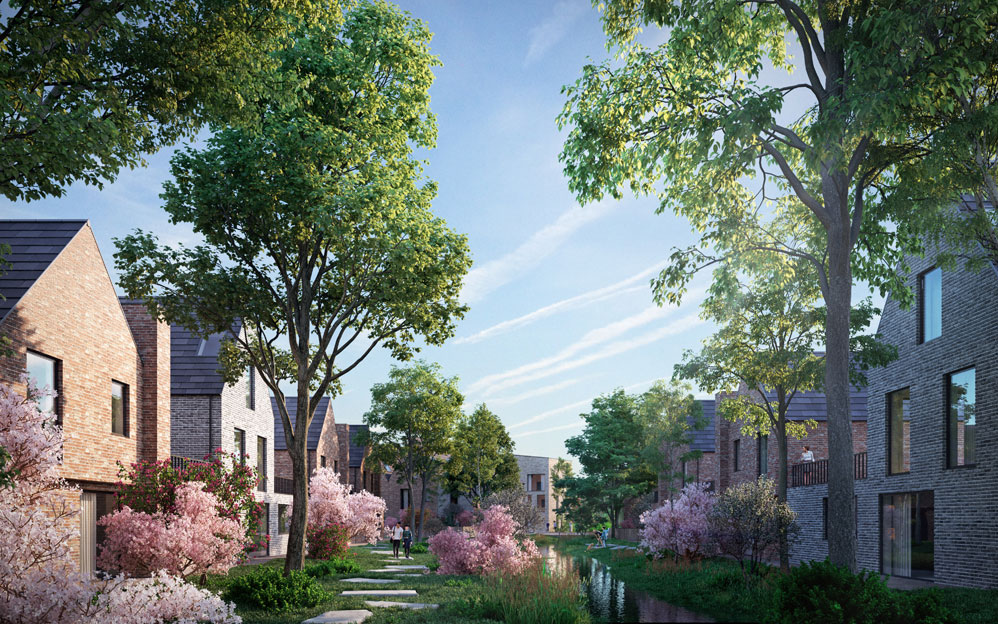
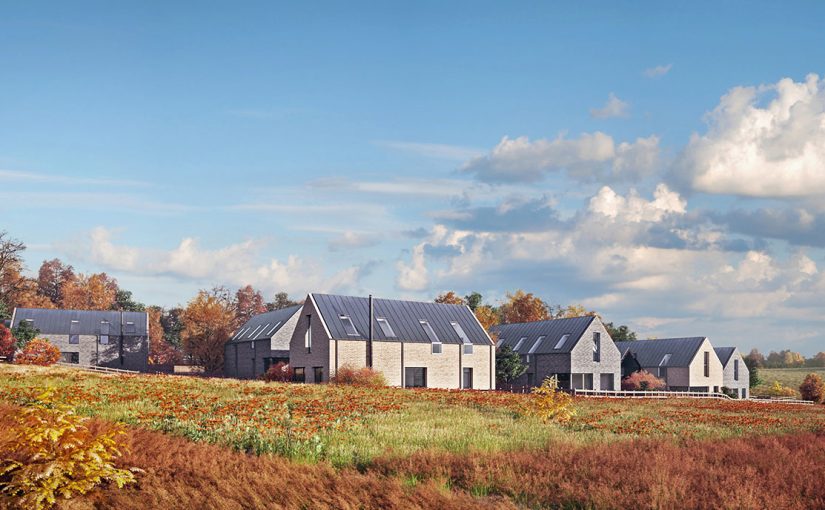
High View Farm is a ‘hamlet’ sized scheme presenting minimal intrusion into the rural landscape of farms and nurseries that surround it. It adapts sensitively to the orientation of the sun, the sloping topography and the views towards the surrounding countryside.

Douglas and King are currently working on construction management in collaboration with See Building Contractors.

The design of the houses is authentic to the traditional building forms of the area, historic barns and small industrial buildings thereby reflecting a distinct and contemporary expression of local identity rather than a suburban townhouse pastiche.

The buildings are exemplars of the possibilities presented by 21st century technology being zero carbon, timber-framed structures. Major components of their superstructure will be factory assembled and delivered to site. These share a commonality that will enable the construction methods to be flexible, economic and sustainable.

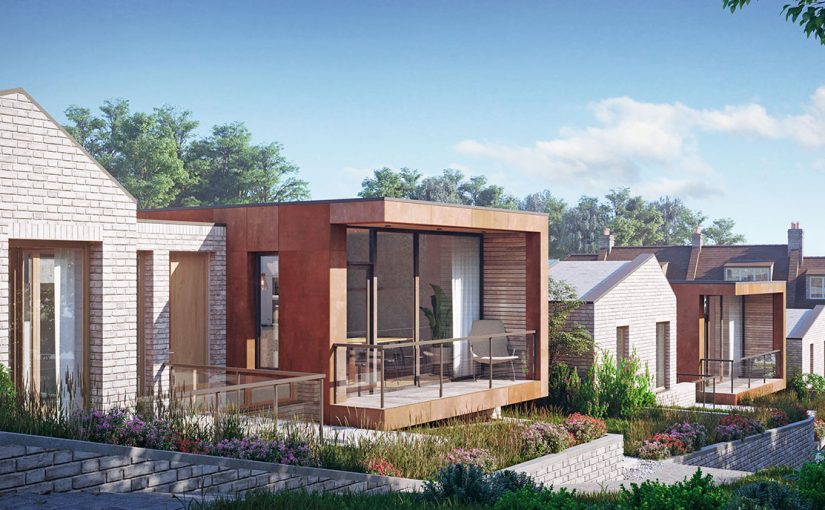
We have designed the buildings with minimal detailing using a palette of materials that reflect the local vernacular – a mix of brickwork and timber cladding.  The pitched roofs are fabricated from zinc and flush-fitting roof lights and windows allow daylight to flood through the internal floor levels.

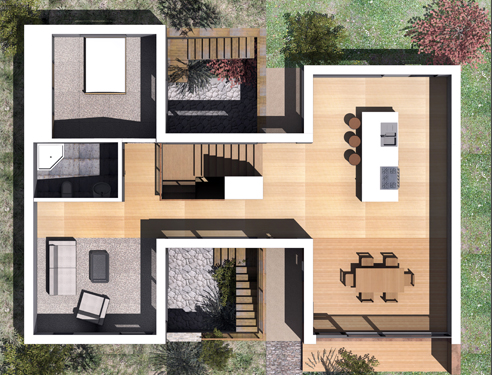
As detached family homes, each one is unique in layout, and they respond to the lifestyles of those who will live in them through a hierarchy of spaces rising from ground to roof levels, public through private, incorporating strategically designed storage at every level.

The landscaping strategy for the site follows an ecological path using native plants and trees to promote biodiversity within a natural environment.  The shared acess areas are planted with trees, shrubs and wild flowers and a central copse sown with reeds provides valuable storm attenuation.

An authentic, sustainable home in the rural Devon landscape

A modern country house as an authentic response to the spirit of place

Architect and Project Manager – Douglas and King Architects
Planning Consultant – Treetops Planning
Structural Engineer – Conisbee
MMC Consultant – Better Delivery Solutions
Environmental and Sustainability Engineer –
Ecology and Natural World –

Detailed planning consent has been granted for the construction of a contemporary county house located in the open Devon landscape close to the Devon and Cornwall border, a few kilometers from the coastal town of Bude. The building is an exemplar of sustainable development, a building that captures the rural spirit of place and is respectful of the historic architectural timeline. The building marries a contextual response to the very latest in 21st Century sustainable construction systems.

To capture the spirit of place we must understand the full historic evolution of local buildings and environment. Throughout history it is the advancement of technology and local knowledge of construction systems along with the availability of construction materials that have defined how our built environment functions and what it looks like. As new technologies have evolved, our homes and workplaces, the way we live and the way we interact with each other have adapted to embrace innovation.

We are interested in authentic architecture. With any new building we work to capture the local architectural heritage and how we can align this to modern lifestyles and innovative construction systems. We do this partly through an analysis of immediate physical constraints and opportunities and partly through an investigation into the  historic evolution of a place.

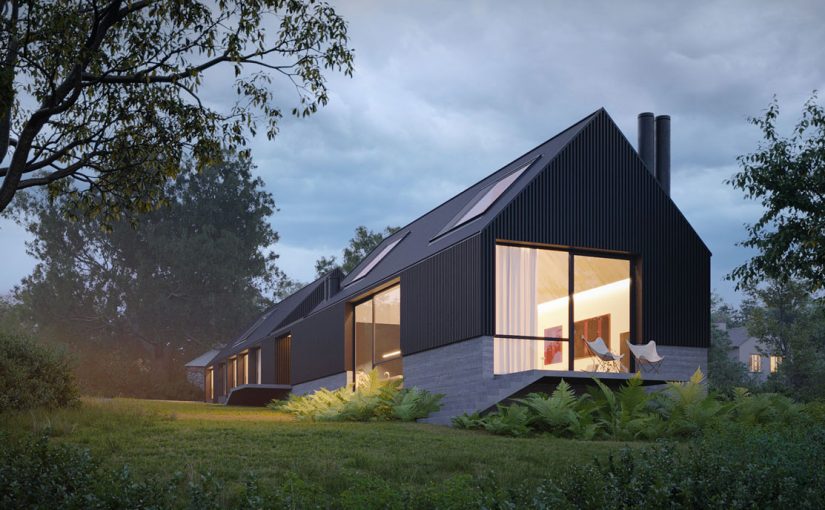
The design of the house is authentic to the traditional building forms of the area, historic barns and small agricultural buildings thereby reflecting a distinct and contemporary expression of local identity rather than a suburban townhouse pastiche.

The building is an exemplars of the possibilities presented by 21st century technology being zero carbon, timber-framed structures. Major components of the superstructure is factory assembled and delivered to site. These share a commonality that will enable the construction methods to be flexible, economic and sustainable.

An careful design was required that would enhance the natural setting and allow the local ecology to thrive. A number of redundant lightweight agricultural buildings on the site are to be replaced by the new building, one Cobb built barn, the home to a family of owls is to be retained. Overall the plot includes a number of fields all of which are bordered by Devon bank hedges. In this part of South West England there are are a number of initiatives to replace hedgerow trees that have been lost from the landscape, partly as a result of intensive farming practices in the 20th century and in part due to diseases such as Dutch Elm and Ash Die Back. We have been working with the Woodland Trust and a replanting programme has been agreed that will see 15 native and disease resistant trees planted.

Whilst redundant structures often offer an ideal habitat for local wildlife, retaining and reparing the Cobb barn and providing numerous new habitats are all part of the strategy to encourage a flourishing and healthy natural environment.

The proposed building is designed to work with the sloping terrain, there is a 15m fall across the site, 3m fall across the length of the proposed house.

Inspiration for the long format of the new dwelling is based on the traditional Devon longhouse, a typology prevalent in the historic landscape where ancient farmers would live with their families on the upper floor of the building and livestock would live within pens on the ground floor. In Devon the longhouses were often built with Cobb, a mixture of straw, lime and the clay dug from local fields. Many of these buildings still exist today, hundreds of years old, proving the robustness of the method.

An access track runs from the country lane to the former paddock, a track that will become the main access route to the new house.

The North South longhouse alignment has been broken into two elements separated by a flat roofed area that forms the entrance to the new house. The broken roofline minimises the impact of the roofline on the open landscape. The shortest elevation, the Northern gable end faces the landscape.

The Northern block is the bedroom area with 4 large bedrooms aligned with a mezzanine level family room under the pitched roof area above. The Northern block faces the garden and orchard to the East, the corridor is wider than normal so that it is not just a corridor or circulation route but also family room facing the garden.

The central circulation area under the flat roof contains a large lobby and cloak /boot room, something that is essential in a county home is an agricultural setting.

The Southern Living block is a double height space that is entered along a platform past the adjacent stair that passes the kitchen area into the dining room in the center of the room. The living / sitting area daces a large panoramic window providing clear views of the natural landscape.

The building has been designed to meet the highest standards of sustainability in use and in construction. Windows and rooflights are aligned to assist passive  solar heating and cooling, smart ventilation technology opens the MVHR ducts and windows to help maintain a constant internal temperature throughout the year.
Whole life carbon profiling is written onto the DNA of the building fabric, leading to reuse specification choices, for example the building will be clad in profiled metal (100% recyclable). High levels of thermal insulation are allowed for meaning that the demand on a background heating system will be very low, the building is designed and aligned so that is does not require costly heating and cooling to function.

An urban artifact for a key vista

An urban artifact for a key vista

Architect and Project Manager – Douglas and King Architects
Quantity Surveyor – Andrew Morton Associates
Clients Agent – John D Wood
Planning Consultant – BNP Paribas
Structural Engineer – Conisbee
MandE Engineers – Flatt
Agent – Stirling Ackroyd

Planning was granted for a proposed community resource building in 2020 following a design programme punctuated by series of pre app and community consultations led by the Architect. Design Management of a large team of consultants was fully managed by the Architect.

The plot is a void in the urban fabric, a vacant site on the main route between Islington and Hackney. The redundant site is at the end of a number of key vistas, on the boundary of two city boroughs, borders a well-known conservation area and is at the junction between two public places. To the East is the Tabernacle Square, a key public space on the route between Old Street Roundabout and the Shoreditch Triangle Conservation Area.

To the East is Tabernacle Square, an urban artefact on the route between Old Street Roundabout and the Shoreditch Triangle Conservation Area. To the North, the site forms part of the Shoreditch Gateway urban space, a public space that is defined by the new Art ‘Otel, the Shoreditch House residential tower and the new 10-storey Picture House that is part of our masterplan proposal for the route between Old Street Roundabout and the Shoreditch Triangle Conservation Area.

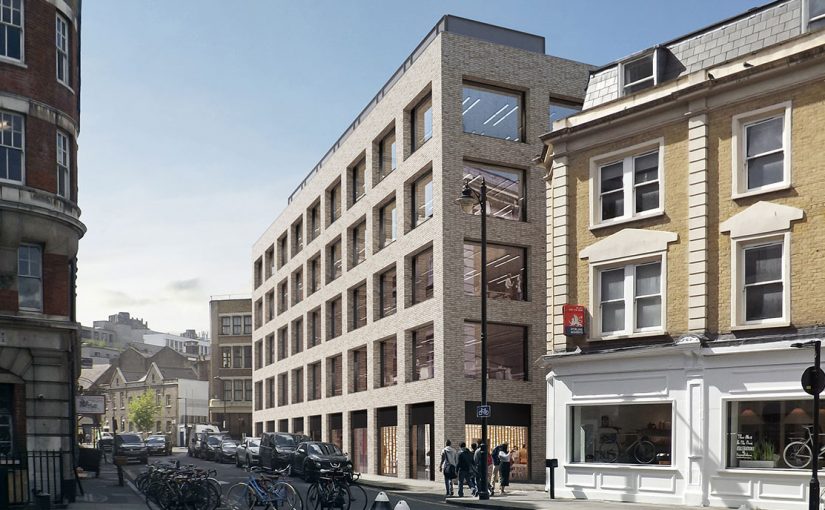
A contemporary response draws on the proportions of the historic terraces that neighbour the corner plot. Minimal detailing is balanced against a careful attention to texture and simple form to create a sculpted building that is a symbol of the maturity of Shoreditch.

Having successfully met the aspirations of our clients and of Hackney Council this project has been taken forward by another team who have redesigned the building for residential use.

The design team and delivery of this planning approval was led by Douglas and King Architects. For information on our processes read our blog on creative leadershio by CLICKING HERE

Corner-Plot-Day-Render_998x691
Public-space-elevations_998x977
3D_998x730
Townhouses-front-elev_998x286
6-Banksy-Shoreditch-998x643

How to put place-making at the core of a new community

How to Put Place-making at the core of a new community

Architect and Project Manager – Douglas and King Architects

Planning Consultant – Countrywide
Structural Engineer – TBC
MandE – TBC

Douglas and King are working with house builders of all sizes throughout the United Kingdom. Our knowledge of creating great homes and successful communities with MMC Technology is helping private sector developers create highly sustainable and community focused projects.

Our proposals aim to create a highly sustainable new neighbourhood on the western fringe of an existing New Town.  The design drivers follow the core principles set out in some of the most successful residential developments of the 21st century.

The site consists of an irregular shaped area of land that had not previously been developed and had the potential to offer a comprehensive development plot as part of a residential-led scheme.

The residential development comprises a total of 130+ homes in a mix of townhouses, mews houses and apartments located around a small communal square.  The range of home types and accommodation suits a broad spectrum of potential users and will attract an inclusive, diverse community.

A network of pedestrian routes has been carefully planned to provide connectivity to the neighbouring New Town, and these share equal parity with vehicular routes.

All streets are landscaped to engender the sense of a natural habitat, and play and public areas have been designed with community ‘policing’ in mind.  The shared access areas are planted with trees, shrubs and wild flowers.  Car parking locations have been sensitively situated throughout the development.

The design of the buildings is a contemporary response to the authentic, pre-industrial vernacular building forms of the area and uses a palette of materials that reflect this.

CHADs-Street-998x624

A contemporary nod to Shoreditch’s architectural heritage

A contemporary nod to Shoreditch’s architectural heritage

Architect and Project Manager – Douglas and King Architects
Clients Agent – John D Wood
Planning Consultant – BNP Paribas
Structural Engineer – Conisbee
MandE Engineers – Flatt
Agent – Sterling Ackroyd

Our vision for Titchfield House creates a BREEAM excellent mixed use building and was granted planning approval in 2020. Douglas and King Acted as Architect, Design Team and Project Manager. The design of Titchfield House draws on the area’s typical warehouse structures and is a contemporary nod to their character and inherent architectural legacy.

The design employs a pure architectural form in direct contrast to the outdated ‘70’s vernacular building it will replace:  a utilitarian afterthought that neither harmonized or neutralized itself within it’s immediate urban context.

Its location is the corner of Tabernacle Street and Singer Street and the new building will strengthen and articulate these two streetscapes both in height and materiality.

At 5 storeys the building matches the existing parapet height of Tabernacle Street with a glazed recessed roofscape reflecting other typical Shoreditch sky space developments.

The new building’s façade was designed to be of a lightweight brick construction with deep reveals to emphasise the purity of the architecture.  The interior will offer high quality working environments, flexible and affordable, aimed at SMEs, to compliment the city fringe businesses and the growth of Shoreditch’s tech hub.

Since the sucessful granting of approval for the building the clients brief has changed and the project has been taken forward by another team hoping to acheive an alternative use on the site.

The design team and delivery of this project was led by Douglas and King Architects. For information on our processes read our blog on creative leadership by CLICKING HERE

Transforming a sloping backland site

Transforming a sloping backland site

Architect and Project Manager – Douglas and King Architects
Planning Consultant – Douglas and King Architects
Structural Engineer – Conisbee

The construction of three modern family houses on a sloping backland site in Muswell Hill was completed in 2017. The DAK design was granted planning by Haringey Council in 2016.

The 1700 sq metre backland site is hidden within a network of residential streets, one of which forms the boundary of a local conservation area.  Following a Pre-Planning design review we led a neighbourhood consultation process over a period of several months that successfully achieved full planning being given through delegated powers.

External corten steel cladding and stonework create a natural response to the immediate environment and the landscape design provides privacy for the living areas of each of the houses.  Light wells to the East and West of each building provide open and light filled basements.  Internal walkways connect the private and public parts of the houses.

stjl-492x375px-muswell-hill-house-a
stjl-492x375px-muswell-hill-house-a-gfjpg

A triangle of place-making

Masterplan Shoreditch - A Triangle of Placemaking

Architect and Project Manager – Douglas and King Architects
Quantity Surveyor – Andrew Morton Associates
Clients Agent – John D Wood
Planning Consultant – BNP Paribas
Structural Engineer – Conisbee
MandE Engineers – Flatt
Agent – Sterling Ackroyd

MasterP-Cover-998x707

Douglas and King undertook the development of a Master Plan and Urban Design Framework for a triangular island site in Shoreditch, bordered by Great Eastern Street (north), Singer Street (west), and Tabernacle Street (south-east).

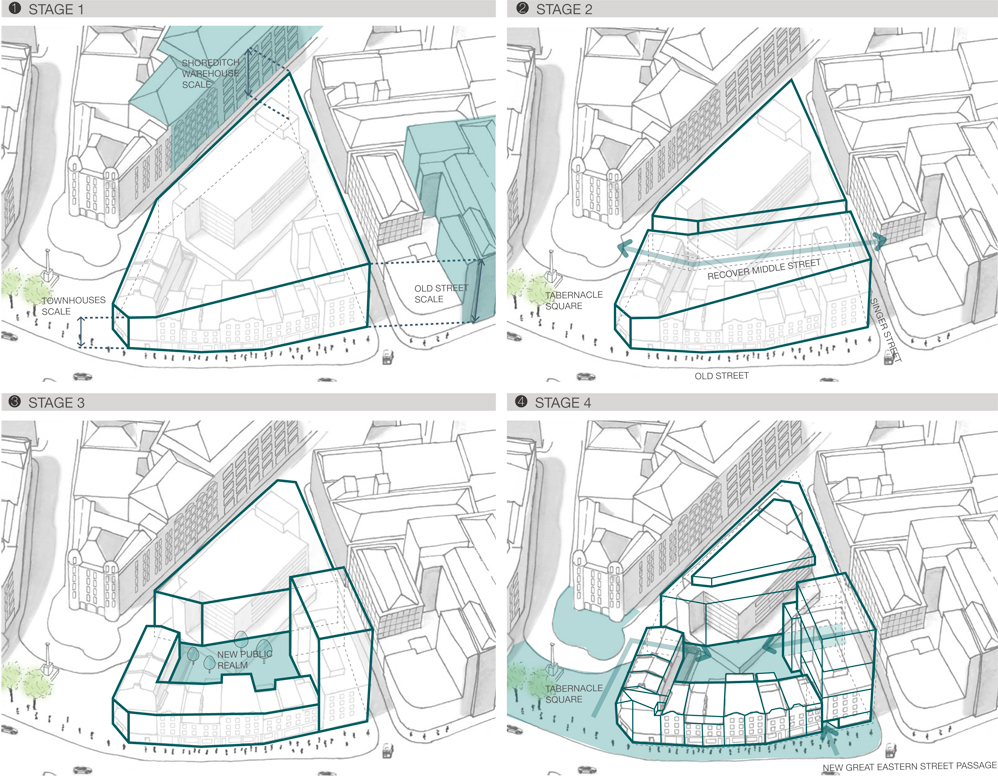
The proposal re-introduced an historic street, creating a new public piazza, re-imagining two 19th century terraces, designing three iconic new buildings which are responsive to their neighbours, and restoring a sense of place to a semi-derelict urban block within the South Shoreditch Conservation Area.

The masterplan drew upon the diversity, optimism, history, culture, and industrial heritage of this part of East London alongside the contemporary influences that now make Shoreditch one of the most successful urban regeneration programmes in Europe.

Shoreditch is an urban paradox that is both free-form and densely continuous:  it is now hosts one of London’s most creative hubs.   It is colourful, optimistic, characterful and its indigenous communities are a strong and vibrant part of this paradox.  Those communities have lived through a period of decline, neglect, traffic driven interventions and those challenges have left a deep-rooted sense of self determination amidst much uncertainty.

Our goals were to enhance the historic fabric of Shoreditch, to express through architecture and conservation the area’s rich history, to mirror the multiplicity of its inhabitants and to protect this Triangle from the commercial hub that is centred round the Old Street Roundabout.

Whilst this project was very sucessful and all the aspirations of the clients brief were fully met, changing market conditions have led to a new design team being appointed to take the project forward with a new brief.

The design team and delivery of this project was led by Douglas and King Architects. For information on our processes read our blog on creative leadershio by CLICKING HERE

OLDs-Location-998x723

Place-making The Triangle

The Triangle Master Plan will re-introduce an historic street, offer new vistas and a new public recreational space. It will restore a terrace of historic townhouses and provide 70,000 square feet of new workspace, retail, and commercial accommodation.  It will be characteristic of the local street boundaries and urban pattern and it will not be a private commercial development.  In keeping with the success of Shoreditch’s regeneration progamme achieved so far, the aspirations of Reitman Yard hinge on the inspiration of the entrepreneurial community that will work, visit, and grow within it’s environment.

How we are doing it

The primary ordering strategy is the shape of the site and the interface it forms between Tabernacle Square/Great Eastern Street, Singer Street and Old Street.  The secondary ordering strategy is the conservation and restoration of the existing historic terraces that form two sides of the Triangle.  The third is the demolition of derelict plots and the re-creation of lost legacies.  The fourth is a considered workplace strategy, and the fifth is the dialogue that the new architecture will have within the Triangle, with its immediate neighbours, and towards the urban character of the adjacent streets.


An open thoroughfare leading to and through a piazza will be at the heart of the development and is central to the intention that Reitman Yard lies wholly within the public realm.   This will also act as a foyer to the inner facades of the buildings and a restful traffic-free backwater to the busy pedestrian and traffic routes in the immediate area.  Contemporary landscaping will re-imagine St Agnes Well, and contribute moments of intensity and tranquillity.  A social space will be defined through the connectivity of cultivation, streetscape and atmosphere


The Physical Assets


The Triangle Master Plan will create a new 10-storey Picture House to the west of the site that acts as an ‘expressive marker’ along the route from Islington to Hackney. The Picture House is the tallest element of the development and our intention is to reflect the typologies of the proposed multi-storey Art ‘Otel, (occupying a focal position opposite Tabernacle Square) and Shoreditch House (a residential tower), on the junction of Great Eastern Street and Pitfield Street.


The existing Titchfield House will be demolished and replaced with a new contemporary building of five storeys that, height-wise, aligns itself with the existing roof levels. It will converse in it’s  21st century style with the architectural character of the 19th century industrial buildings along Singer Street and Tabernacle Street.


95 Tabernacle Street is currently a void in the urban fabric of the site and is the most visible aspect of the development as its corner position is a key local node on a principal point of intersection. An iconic galleried building informs the extension and re-imagining of the two adjacent terraces of townhouses. These are to be re-designed to create front to back shops, an architectural intervention that will provide glimpses through to the life of Reitman Yard.

MaterPlan-Courtyard-materials_998x1085a

What it will be like

The Triangle Master Plan confidently and consistently reflects the strategy of LB Hackney for the South Shoreditch Conservation area.  Each component or building can be designed individually in response to its immediate and neighbouring context.

The proposals for Picture House, Titchfield House and 95 Tabernacle Street are explained in more detail elsewhere on this website.