Practice News 2017

5th December 2017 – Planning Submitted for 90,000 sq ft Old Street Project

Our project to re-imagine a historic quarter of Shoreditch creating a new public space, 2 large commercial buildings and creating a small landmark building have been submitted for Planning following extensive design development within a Planning Performance Agreement with Hackney Council.

19th November 2017 – Construction of 3 New High-end Penthouses in Highgate Begins

Our plans to modify an existing mixed-use building and to add 3 new penthouse apartments has started on site along Archway Road. Planning was granted in January 2017 following successful negotiations with the local authority.

17th November 2017 – Camden Conservation Area Retrofit and Extension, Planning Submitted

Douglas and King have been developing designs for this sensitive site for a number of years. Planning has been submitted following extensive negotiations and reviews with the local Conservation Area Advisory Committee (CAAC).

31st October 2017 – Seven Sisters Road Mixed Use Awarded Planning

Islington Council has given the green light for our mixed-use development of apartments and workspaces.

5th October 2017 – North London House Submitted for Planning

One of several purpose-built private houses for individual clients currently in planning or under construction. Barnet 11 has been submitted for planning using the Council’s fast track planning process.

(20th December 2017 Update – Approved Subject to S106)

6th October 2017 – Planning for a New House in Wandsworth

This project creates a new dwelling on a narrow infill site in Wandsworth. Following negotiations planning has been submitted for this contemporary family home with a tiny footprint.

15th September 2017

Yet another excellent DAK member passes the Part 3 post, well done Mr Christopher Perry RIBA. As one of our favourite clients would say ‘let loose the dogs of war’ (From Julias Cesear)

1st September 2017 – Mid Century Building in Barnet to be Converted into a 21st Century School

Douglas and King are delighted to have been appointed as Architects to extend and covert a former synagogue into a primary school for the local Jewish Community.

14th September 2017 – Shoreditch Projects Widely Published

12th August 2017 – Designs Revealed for Greenwich Mixed Use Retro-Fit

The practice is working to secure planning permission that upgrades and extends a large listed building in the heart of Greenwich.

22nd July 2017 – Planning Approved for Croyden Apartments

Planning has been granted by Croydon Council to significantly refit and extend an existing apartment building. Construction is expected to commence on the 9 unit scheme in January 2018.

12th April 2017 – Finchley Road Apartment Building Starts on Site

The piling and groundworks for our £3.5m apartment development on Finchley Road in London is underway. The project is led by Douglas and King Architects as designers and Contract Administrators.
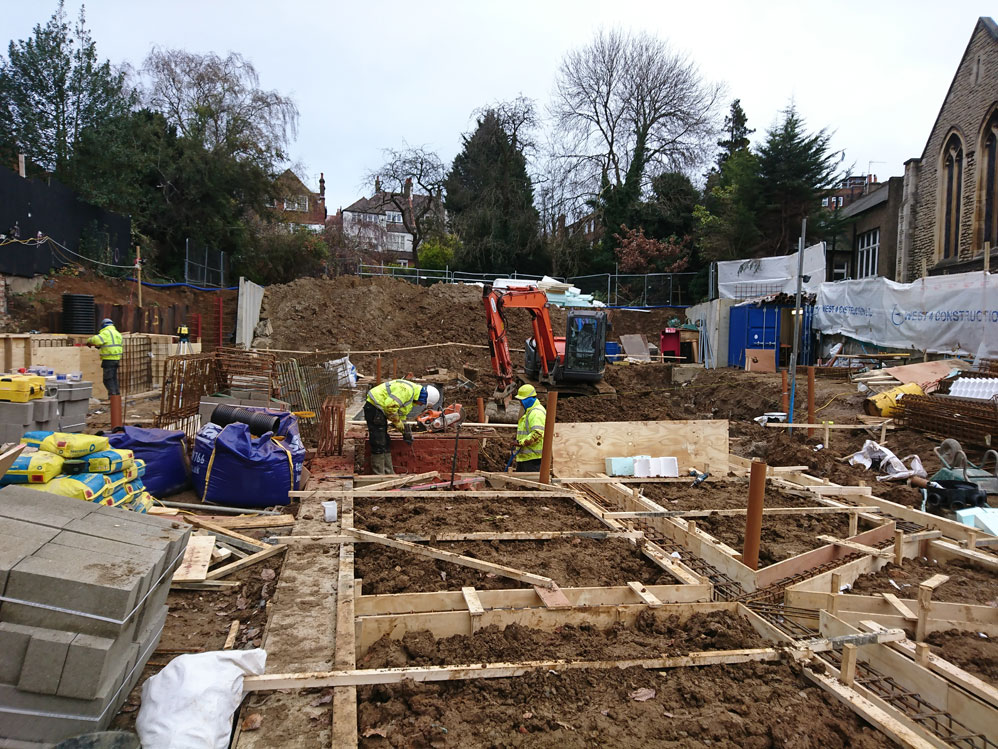
15th March 2017 – House in an Urban Woodland Starts on Site

One of several new-build family homes we are designing on London backland sites to reflect the need for these sites to be re-appraised as suitable for small dwellings. Occupancy should take place in early 2018. Click here for the design story.

10th February 2017 – Crossrail Apartments in West London

The practice are working on multiple residential developments along the route of the new Crossrail, Elizabeth Line. This particular project is for a private landowner who wished to develop three separate units of apartments in Hillingdon. Construction is expected to start in early 2018.

1st February 2017 – Contemporary Working Community created in Historic Hackney Warehouse

Our project to create 14,000 sq ft of mixed use commercial space in Hackney Wick has been completed and the project is now fully occupied. More Details on this highly efficient commercial building can be found by Clicking Here.

Bansky and Noir pull punters into Shoreditch

We have witnessed at first hand the district’s transformation from an inner-city backwater to one of Europe’s most vibrant social, business and creative quarters. We love being here and champion the rich mix that the area offers.

It was the dereliction of the industrial landscape that set the scene for the first creative influx into Shoreditch. In the ‘70’s through to the ‘90’s the large post-industrial buildings, some in a derelict state, were colonised by individuals who were making their emergence on the countercultural scene developing in London in those decades.

The sprawling energy of the area mirrored their rejection of ‘formal’ art.  The cheap rent and availability of the area’s large lofty spaces encouraged them to set up studios for co-working, collaboration, etc and many continue to live and work in Shoreditch today.

Individual inhabitants of these decades included Damien Hurst, Alexander McQueen, Tracy Emin, Sam Taylor Wood and Gary Hume.  By the early 21st c the White Cube Gallery in Hoxton Square was hosting exhibitions by Gilbert and George, Donatella Versace and Kate Hudson.

Pioneering venues included the former Blue Note Club in Hoxton Square and the Strong Room recording studios on Curtain Road, the latter of which has always had an arts led agenda and the ceiling of the lower bar has a large canvas by the Punk Rock artist Jamie Reed.

It was not long before this countercultural trend spilled out onto the streets in the form of graffiti, wall art, music and ready-made sculpture. Significant works by Banksy and Noir can be passed by on the streets of Shoreditch – its public art gallery is open to all.

‘Let us Adore and Endure Each Other’ illustrates in every way the paradox that characterises Shoreditch. The spontaneity of its message and execution across the city of Philadelphia reflects perfectly every stage in the history and evolution of Shoreditch.

adore verb (LOVE)

to love someone very much, especially in a way that shows a lot of admiration or respect

OR to like something very much

endure verb (EXPERIENCE)
to suffer something difficult, unpleasant, or painful:

The area has embraced and endured change in every century of its history and these transformations have left indelible physical and cultural markers visible throughout its urban landscape, streetscapes, periods of decline and its eventual ascent.

The themes that run through the Shoreditch story are the street and public arts narrative of the area.

+-8-Noir-998x749

Creative Workspace Available

What’s this about?

We are very lucky to work from a beautiful warehouse studio on Curtain Road in Shoreditch. Although our businesses are constantly developing and growing we occasionally have desk space that we let to friends and collaborators.

The studio is light and bright, we have a shared kitchen and meeting area and the desks are very large.

Where?
Our studio is located on the top floor of a Victorian Warehouse. We are located bang smack in the middle of the Shoreditch creative hub, 5 minutes from Old Street Underground, Liverpool Street and the very excellent Shoreditch High Street Overground Station. The studio is in a unique location set back from Curtain Road and is secure and quiet.
 
Why?
Shoreditch is well known as a hub for incubating start ups and as an area for SMEs to thrive. We enjoy the varied atmosphere that other disciplines bring to the studio.

How?
We ask only for one months deposit and one months notice. We are happy to issue a license and do not charge VAT on the desks. The desks cost £500pcm. BT broadband is available and a number of lines exist into the studio if you wish to install your own (ideal if you are an IT / Web business – hang off our system whilst you settle in).

Who?
If you wish to view the space please contact Lucy Von Denman at DandK on 0207 613 1395

.

Don’t obstruct the light

Our original intention to explore how we design buildings for daylight in terms of design and in terms of the legal position of a right to daylight of neighbouring buildings. This piece was an attempt to unravel the legislation surrounding one of the oldest design dilemmas, the issue of ‘Rights to Light’ particularly in terms of side-by-side buildings in a dense urban context and separately how we as architects use daylight and orientation as one of the primary drivers in our design process.

After some reflection it seemed that it would be more informative, and enlightening (sic) to travel back in time and refer to the first treatise published on this subject by Vitruvius.

Vitruvius was a Roman author, architect, civil and military engineer during the 1st century BC and is best known for his multi-volume work entitled De architectura. His discussion of perfect proportion in architecture and the human body, led to the famous Renaissance drawing by Da Vinci of Vitruvian Man.

Early architects understood the importance of designing a building that was responsive to its position and orientation.  Vitruvius wrote as follows within his five fundamental principles of architecture:

 ‘There will also be a natural proprietary to use an eastern light for bedrooms and libraries, a western light in winter for baths and winter apartments, and a northern light for picture galleries and other places in which a steady light is needed; for that a quarter of the sky grows neither light nor dark with the course of the Sun, but remains steady and unshifting throughout the day’.

It would have been possible then (as it is now) to create models and measure their daylight performance over a given period of time in varying orientations.  This would have informed how the floor plan could best accommodate room arrangements and uses, both internal and external, window placement, etc.

Alongside these considerations other factors played a part – you’ve guessed – windows.

Glassmaking was already remarkably advanced during the Roman era, and many ancient homes had glass-paned windows. The earliest windows were panes of glassy pebbles laid on a wooden frame — these would let some light through, but probably weren’t that transparent. Clear glass panes were first invented in the late 3rd century CE, when glassmakers would blow a cylindrical bubble of glass and then slice it lengthwise and flatten out the results.

During the so-called Dark Ages, this technology, like so many others known before the Fall of Rome, somehow got lost. While cathedrals across Europe made use of stained glass for their windows, domestic windows were totally unglazed, with only wooden shutters to keep out the cold. Some people took thin animal hides (or parchment) and soaked them in oil to make them as translucent as possible. They also had to keep their windows (and doors) pretty small, to minimize the drafts, and whenever possible, curtains or mats further helped with insulation. This is why interiors were so dark back then, with the never-extinguished fire providing most of the light.

It was from the Renaissance onwards that architects were able to employ glazing as an integral architectural element and to exploit it in grand public structures.  The potential of double-height or enlarged ceiling heights enabled daylight to be reflected and distributed in innovative ways as it had been in the cathedrals of the Middle Ages.

Roof-lights, light-wells, enlarged and strategically located windows all contributed to the building’s response to its immediate environment and the natural progress of the sun throughout daylight hours.

In spite of the many overwhelmingly convincing arguments for natural light to be exploited as fully as possible within the domestic and working environments there are no guiding principles that indicate the relevance of designing ‘healthy’ buildings that respond to orientation and sunlight and impact as little as possible upon their immediate surroundings.