Transforming construction in the digital age

In this article we describe some of the factory building systems that are widely used in the construction industry throughout the UK today. Modern methods of construction employ a radically different approach to that of the past and minimise the on-site activity. They offer many advantages in terms of shortening construction schedules, a greater degree of predictability in cost, reduced material waste, reduced carbon emissions and greater safety and security on site.

The process of off-site construction involves planning, designing, fabricating, transporting and assembling building elements for rapid site assembly to a greater degree of finish than in the traditional piecemeal on-site construction processes.

We have explained elsewhere that the urgent need for more homes stretches back to the 19th Century when industrialisation drove a huge rise in population. We have explained how historically it was the new technology of the age that enabled the creation of the mass housing projects of those times.

Today, as we live in a digital age we have developed building systems that allow us to create high quality houses at a comparatively low cost though computer aided design and off-site construction. In our article ‘Designing Homes, The Argument for an Authentic Approach’ we explain how authentic buildings can be created with timber frame and other modern methods of construction.

In this discussion we look at the factory built systems that are readily available and why these methods, when coupled with a place-making strategy, can create authentic, successful vernacular houses that are fit for contemporary lifestyles.

Factory-Image-998x421

Part 1 – Construction Systems in Timber

Timber has been used in the construction of buildings for thousands of years. The main building construction method shifted from timber frame to load bearing masonry at the time of the industrial revolution when bricks, blocks and other building materials were first mass produced. Today’s advances in technology and manufacturing has re-introduced timber construction as the main structural component in house building.

Timber is the central material in off-site construction and as it is a renewable, low carbon material it offers a number of different options within the factory production process. We describe some of these options below.

Timber Frame Construction

Timber frame is probably the most commonly employed off-site construction system in the UK. Walls, floors and roof panels are assembled as cassettes by computer controlled production facilities. This computerised process allows each component to be unique and introducing variety to the design palette i.e. each individual dwelling can be designed to match the needs of its occupants and to its context in the landscape.Cassettes can either be Open or Closed Panels. Open Panel cassettes are simply timber frame structures whereas Closed Panel Cassettes involve a greater level of completion with the factory installation of windows, apertures for services, breather membranes etc.

Timber-Frame-Construction-998x611

Oak Frame Construction

Oak frame construction involves the factory fabrication of large oak frames that are delivered to site to be fixed in place. Oak frames can be incorporated into the buildings in a number of ways and can be assembled with SIPS panel infills as described below.Oak frames are popular in self-build projects because they offer speed of construction coupled with the historic and authentic method of construction. They also offer a natural aesthetic if the building fabric is to be used as a external feature.

Oak-Frame-Construction998x749

Cross Laminated Timber

CLT is a structural laminated timber panel system that is used to create solid timber walls, roof and floor panels. CLT is produced by gluing laminates two ways and by finger jointing soft wood in layers that are set at 90 degrees to each other.

CLT is a very successful construction process as it has a high loadbearing capacity, and high levels of acoustic, fire and structural performance. CLT is used in most building types and is popular among architects particularly for its beautiful aesthetic appearance.

CLT-998x749

Part 2 – Volumetric or Modular Systems

Volumetric construction involves the full fabrication of large components that are delivered to site. An entire house can be built from just a few modules that, when delivered to site, require no more than light finishing and decorating once assembled.

Factory production of such large components that are delivered complete with fixtures and fittings means that there are very few defects in the completed building. The main advantage of Modular Construction is the speed of assembly with houses completed within days.

Volumetric construction does not mean that every component must be identical. Computer controlled construction in factory conditions allows for flexibility and variety in building forms and material finishes. Architects use BIM 3D computer programmes that work hand in hand with manufacturing technology to deliver buildings that are responsive to their location and occupation.

Volumetric-998s561

Part 3 – Structurally Insulated Panel System (SIPS)

The SIPS system provides completed cassettes with oriented strand boards (OSB) and a full polyurethane or expanded polystyrene insulation.

SIPS panels are widely used in house building. They provide components that do not require any other form of structural support, offer high levels of insulation and can be rendered fully air tight at the point of assembly.

Sips-Panel-Construction-998x749

Part 4 – Lightweight Steel Frame Construction

Lightweight steel frame construction is becoming increasingly popular in the UK. Lightweight loadbearing galvanised steel frames are factory assembled and fixed together on site to create the structural envelope of a building.

Steel frames are dimensionally accurate, embody a very high strength to weight ratio, have longevity, and are adaptable and fully recyclable.

The benefits of lightweight steel construction are similar to those of timber construction. The high strength characteristics of steel reduce the size of structural members and spans can be increased without the need for additional supports. Less structure offers more room for insulation and finishes, steel framed buildings can be highly energy efficient in use.

Lightweight-Steel-998x749

Anomalies in the urban grain redact the housing shortage

UPDATE: 10/12/2019

The New London Plan referred to below has been through several rounds of consulation with the hope of adopting the policy before the 2020 London Mayoral Elections.

The Planning Inspectorate has objected to key componants including elements of  Policy H2 relating to Small Site development and densification. Whilst commenting on issues like Green Belt review and the difficulties in developing small sites the Inspectors do note that the consequences of not adopting a London Plan would be worse than adopting one that does not meet the capital’s development needs.

The London Mayor is planning to respond to the Planning Inspectorate objections by Chrismas 2019 and it will then be more clear to what extent the New London Plan will be adopted as policy in 2020.


Original Blog from December 2018 Continues Below:

London’s population has grown exponentially during the last three decades and by 7.5% in the last three years.  It is set to rise to 10.2M by 2036.

This demand equates to a need to provide at least 66,000 new homes per year over the next 10 years.

Approximatly 40% of these will be built on small sites, below the area threshold of 0.25 hectares.  Development of these small sites with a capacity of 1-25 new homes will substantially contribute to the new housing supply across the city.

Below we look at the impact of 2017 The Draft London Plan and The London Mayors new Housing Strategy.  We go on to explain why these commendable and ambitious frameworks will enable and support collaboration between planners, house-builders and architects.

We also look at how Boroughs will need to acknowledge and endorse the advantages of small housing developments within their local development plans and specific planning decisions and how this type of ‘micro’ development can be accommodated in different locations and with varying densities and dwelling types.

10 Year Housing Targets by Borough. Large Sites Black + Small Sites Orange

There have been many previous studies that have looked at how much land might be available from smaller sites throughout London. The SHLAA (Strategic Housing Land Availability Assessment) is the latest analysis and is based on a statistical analysis of the likelihood of small sites becoming available rather than a detailed review based on an analysis of hard facts.  Authors note: (3D Google Earth should surely be an aid to measuring and identifying such sites in 2018).

In 1998 The Friends of the Earth commissioned a study “Tomorrow a Peaceful Path to Urban Reform” which examined how different types of urban patterns could be used to increase urban density.  It also identified that existing residential areas have the capacity for intensification, i.e. the possibility of increasing housing density without increasing the population density.  It cited the following examples.

However there are a unique set of parameters (rules) that need to be addressed to optimize development on small sites so that they benefit the wider community and are not detrimental to residential privacy, designated heritage assets, biodiversity or a safeguarded land use.
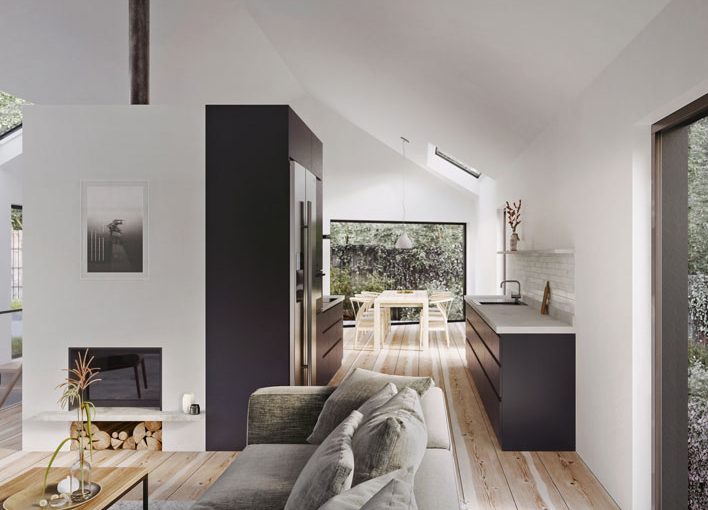
At Douglas and King we have a history of delivering housing projects on small sites throughout London.  We became experts at analyzing the suitability of a site, the type of development that might meet with approval with local Planners, and gain consensus from the residents living nearby.

We actively engaged in the process of Pre-Application engagement with local planning authorities to overcome issues that could be detrimental to the Planning outcome, and to establish the exact parameters that would satisfy the local development plan.

We championed what is now cited in the Draft London Plan as future policy, The Presumption in Favour of Small Housing Developments and fought our corner against what was a borough-wide policy, The Presumption Against Approval.

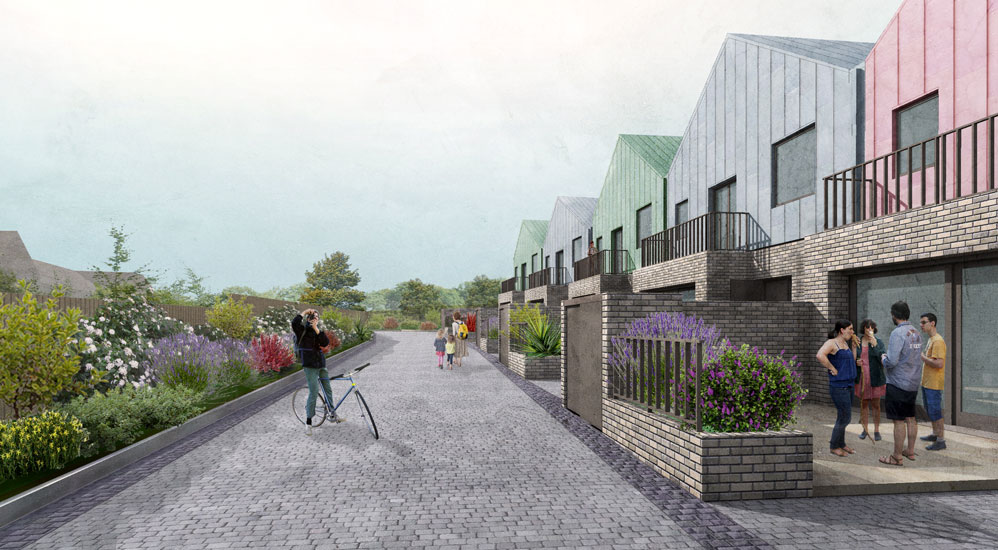
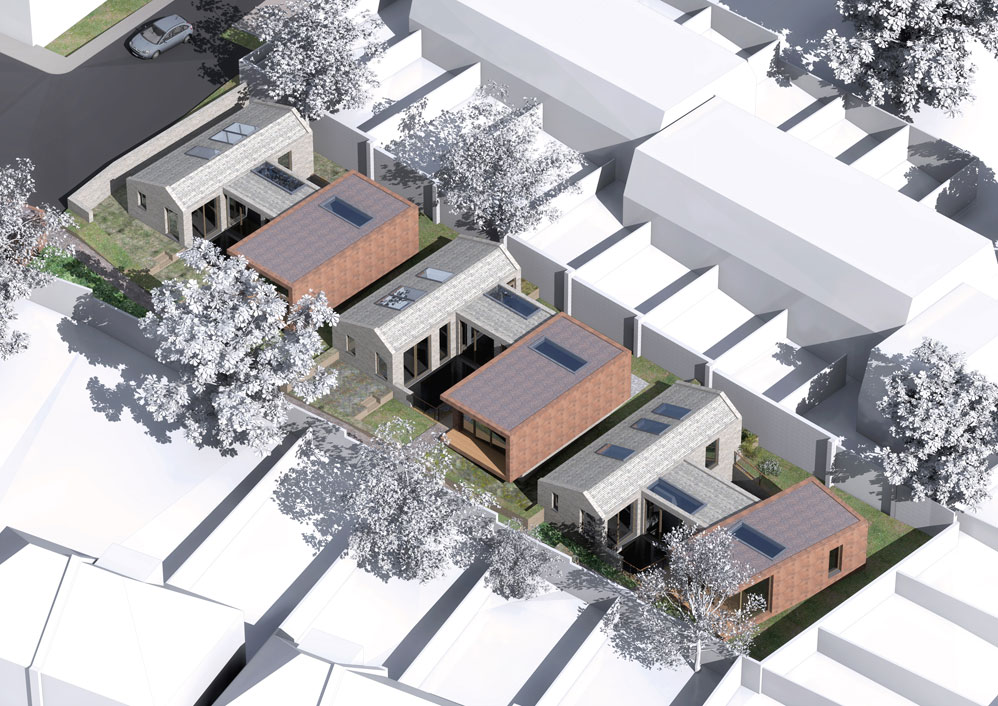
2019. 10 New Homes on a backland site in Barnet.

The Role of Small Sites in Achieving London’s Housing Delivery Targets

Part H2 of the Draft London Plan notes in detail the aspirations of the Mayor’s office for small sites development:

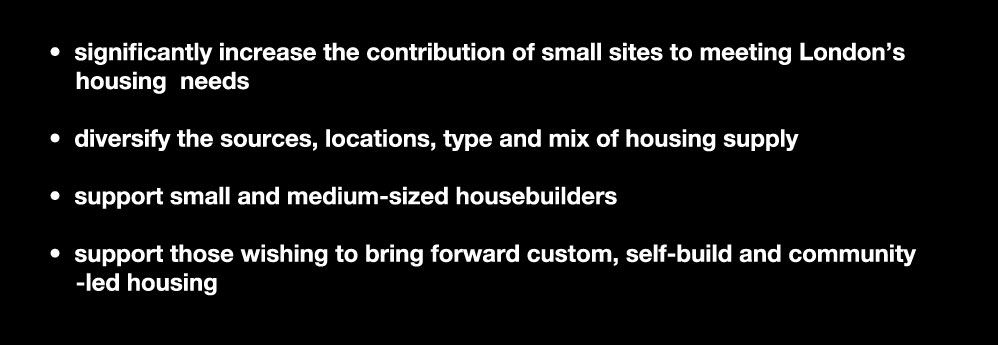
“Small sites should play a much greater role in housing delivery and boroughs should pro-actively support well-designed new homes on small sites through both planning decisions and plan-making in order to:

The Mayor’s Office recommends that London Boroughs should ‘recognise in their Development Plans and planning decisions that local character evolves over time and will need to change in appropriate locations to accommodate additional housing provision and increases in residential density through small housing developments’

The Mayor’s Office recommends that London Boroughs should apply Planning policies In Favour of Sustainable Development of the following small sites (0-25 residential Units):

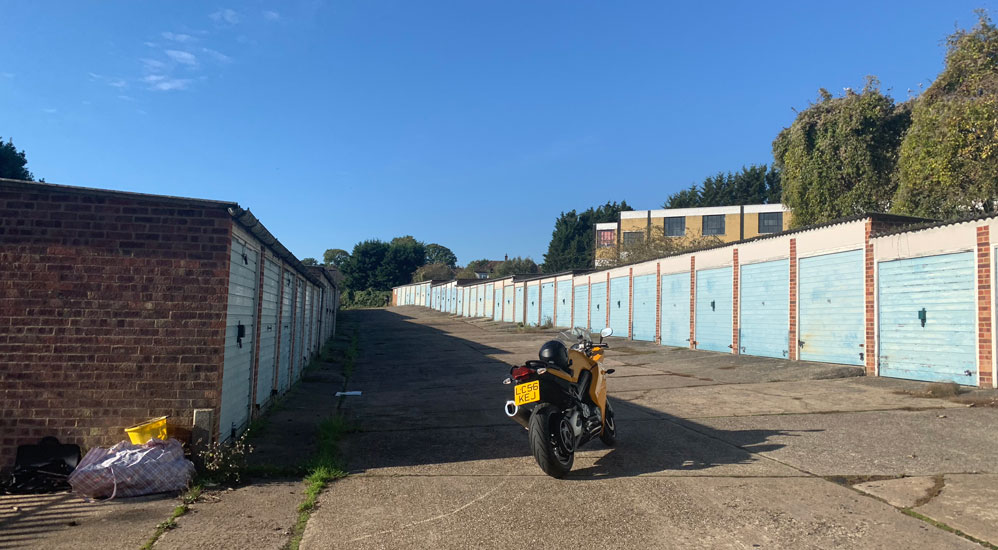
Ideal plots for these kind of development are those that can be described as anomalies within the ‘Urban Grain’.  By this we mean that a garden may be substantially larger than its neighbours, or of the garden sizes prevalent within the neighbourhood.  Street patterns can also determine or demonstrate these anomalies and these can be researched through consultation with up to date site-specific maps.

At Douglas and King we carefully consider the following issues when we appraise a small residential development site:

There are a number of studies and surveys we carry out to establish the outcomes of the above including, for example, a Visual Impact Study to appraise the development’s impact on neighbouring buildings

The Role Boroughs and Planners Will Play in Appraising Appropriate Small Site Locations

Planning Policy in London will change in response to the Mayor’s aspiration to increase the built density of London’s housing provision. The extent of the proposed changes in density will require Planners and Londoners to accept the fact that significant parts of their built environment will need to evolve in character and form.

The London Plan sets out a framework for good development under the following headings:

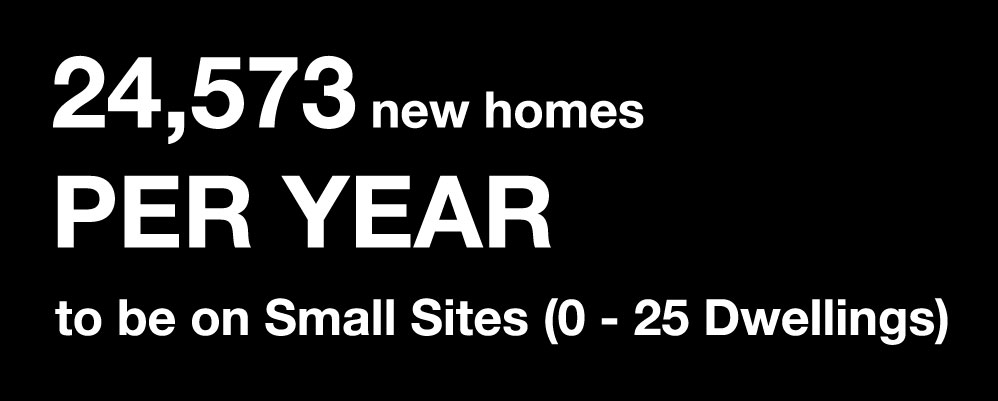
SLHAA Assessments show that small sites, subject to revisions in local planning policy with a ‘Presumption in Favour of Development’ will represent 24,573 new home completions per year over 10 years.

Our Ambition to Create Homes that are Truly Representative of the 21st Century

The London Plan’s ambition to create more and better designed homes for Londoners now and in the future is shared by the architectural profession.  We also have ambition to create homes that are truly representative of the 21st century and the diverse needs of their occupants.

Aesthetic prejudice to contemporary architecture often dismisses housing solutions as inappropriate so it is important that architects demonstrate their approach responds to the particular characteristics of a site in a clear and cogent manner, that it is not style-based but rather an authentic response to site-specific conditions and has been conceived to maximise the quality of the environment it will create.

Planning officers should be encouraged to have an open-minded approach and to have a greater understanding of the architectural intention. Planners should accept that there will be changes to street-scapes, building densities and social infrastructure. Planners should dismiss pastiche design that attempts to replicate one or another from a preceding era.  This is unacceptable and undermines both the historical and future legacy of our city. Planners should be pro-active in explaining the benefits of local small developments to their communities. If it is the Architects responsibility to engage with the local community then it is essential that Planners step up their role in communicating the local plan and the message that if it is done well it will be for the greater good.
Let’s not forget the mistakes that have been made and ensure that they are never repeated….

Garden grabbing policy dropped in revised London Plan

Creating new houses on Gardens and Back Land Sites in London is not always “Garden Grabbing” as it can sometimes be derisively described. To be successful this type of development does require evaluation and assessment, and careful consideration of the relevant issues.


So here’s a useful Overview of the Risks Involved.  There are the obvious ones such as Planning Consent, Party Wall Agreements, Construction Costs and the less obvious ones (but equally relevant) such as the Suitability of Plots, and Issues such as Access, Utilities, Restrictions, Land Ownership, etc.


For a specific analysis of a plot please contact the design studio and we will be happy to discuss a potential development with you and can also provide you with a copy of our publication ‘individual dwellings’ and a fact sheet on this topic.


Please Email info@douglasandking.com with the title ‘Individual Dwellings’ for a copy of the publications.


Many outer London borough homes have abnormally large back gardens and extended ‘backland’ areas adjacent to them.   At first sight they would seem to be ideal for the construction of a new dwelling. However there are a number of potential hurdles to overcome to achieve a successful outcome and in this blog we run through the main issues to be aware of.


Ideal plots for this kind of development are those that can be described as anomalies within the ‘Urban Grain’.  By this we mean that a garden may be substantially larger than its neighbours, or of the garden sizes prevalent within the neighbourhood.  Street patterns can also determine or demonstrate these anomalies so accurate and up to date site-specific maps should be consulted.

2-OldPr-Arial-998x723

The topography and orientation of a site are also important. It is common to reduce the impact of a new building by working with the existing land levels.  These can become an integral design component by for example, creating semi-subterranean buildings and/or designing low Impact environmentally friendly dwellings.

3-STJm-998x706

A new dwelling will need to be accessed from the public highway and permission may be required from the local council’s Highways department to create a new crossover. It is vital to ascertain whether access routes cross land or title owned by others as permission will be necessary in order to create a new access i.e. a driveway and whether the access allows for the routes of utilities below ground. The latter is commonplace in land bordering railway lines and/or land owned by utility companies.


Prospective developments must establish land ownership and any easements or rights of way within the land registry deeds. The title deeds for a property will set out any conditions that might restrict the development of a piece of land. Restrictions can be anything from rights of way to services within the ground. The title deeds can be obtained online from the land registry website.


It is important to double-check that no significant below ground services run beneath the site. This can be anything from a community sewer to a large electrical cable supplying power to a nearby substation. Comprehensive amenity drawings be obtained from mapping specialists who hold records provided by all the major utility companies

4-Pipes-in-Ground-998x749

Many back land developments that are refused planning by the local authority are often successful at a second appeal stage. Planning appeals are submitted to and decided by the Planning Inspectorate. The Planning Inspectorate is an executive agency for the Department for Communities and Local Government. They are in turn informed by the NPPF (National Planning Policy Framework).


Our recent project ‘House in an Urban Woodland’ was granted planning consent in 2016 for the development of a large rear garden in the London Borough of Barnet after the initial Planning application was rejected. The project is one of a number of new dwelling developments on former garden or back land sites that the practice is currently working on.


Please Email info@douglasandking.com with the title ‘Individual Dwellings’ for a copy of the residential brochure and the information sheet relating to garden or back land development.

Multiplying the Residential Model

Our approach to the layout and design of homes has emerged through years of testing, exploring, engaging, measuring, listening and learning.

We are committed to creating people-centered dwellings that are inclusive where full consideration has been given to the dynamics of age, lifestyle, function, circulation, level, light, insulation and well-being.

The formulae that we apply to the design of the domestic environment is the common thread we apply to different types of dwellings whether they are individual houses or apartments, multiple residential buildings, or homes converted out of buildings which had former uses.

So in this blog we discuss the key drivers behind the ways we have applied these formulae to a variety of seemingly ‘singular’ dwelling types and will demonstrate the commonality of our approach.  The standard for living that we apply is based on guidelines that have evolved elementally through the processes we describe above and below.  We begin with the question:

What Do We Want From A Home?

The Essential Ingredients

Privacy   noun

a state in which one is not observed or disturbed by other people’

Sanctuary   noun

refuge or safety from pursuit, persecution, or other danger’

Harmony   noun

‘the quality of forming a pleasing and consistent whole’

Individuality   noun

 ‘the quality or character of a particular person or thing that distinguishes them from others of the same kind, especially when strongly marked’.

Comfort   noun

‘a state of physical ease and freedom from pain or constraint’

Safety   noun

‘the condition of being protected from or unlikely to cause danger, risk, or injury’

Sociability   noun

‘the quality of liking to meet and spend time with other people’

Ritual   noun

‘a series of actions or type of behaviour regularly and invariably followed by someone’

In this section we describe how we evaluate space calculations and how we consider functionality, circulation, lifestyle and context.

Space

The Mayor of London has provided space standards for dwellings as indicated in the infographic below. As architects we interpret this as the baseline for space calculations for individual dwellings.

Functionality

Homes must function efficiently on a daily basis and not just as a theoretical model.

Circulation

A feature that is common to many of our current projects is a double circulation system.  We like to create a plan that gives more than one way to move around a series of spaces – the private and the public routes.

Entrance

The first impression and a pause space, a welcoming space and from which the arrangement and character of the dwelling can be seen and understood.

Privacy

Spaces are created that allow the inhabitants to be on their own, to be together or to be with guests.  Hierarchical spaces can be introduced into internal layouts to encourage different levels of privacy.

Comfort

Homes should be designed to provide comfortable relaxing environments that facilitiate individual and collective activities.

Storage

Daily, weekly and long term storage are essential for a clutter free home. Opportunities to create functional and accessible storage spaces can be found in hidden spaces or internal voids.

Adaptability

Homes should allow ‘room to grow’ and be adaptable to the changing needs of its inhabitants as they progress through their lives.

Live/Work

It is important to integrate into the overall design areas where people can work at home. The ability to work from home has become a critical component of the 21st century lifestyle.

Designing a Home: The Individual Model Multiplied

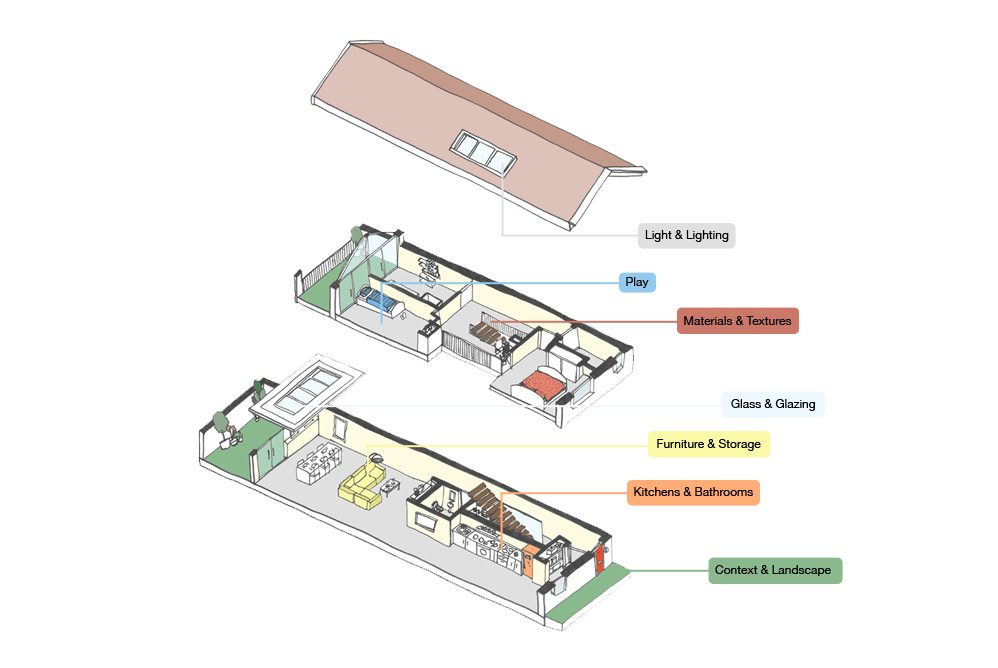
Here we give an example of an Individual Model illustrating Options 2 and 4 below:

Axo-with-labels-998x668

Designing a home that fulfills the expectations of the end user(s) begins with assessing the accommodation needs of the individual(s) who will live within the residential units.

There are many options and possibilities to be considered and each of these can be integrated into the design of multiple occupancy buildings.

Below we list some of these options:

Option 1: One floor accommodation type: Apartment

a) Apartment living for one person (example)

b) Apartment living for two people (example)

c) Apartment living for a family of two parents and up to three children (example)

d) Loft Style Apartment converted from the interior of a building with former use

Option 2: Two/three floor accommodation: Townhouse/Split level apartment/Conversion of a building with former use

a) Townhouse on two floors (Conversion example)

b) Townhouse on two floors (New-build example)

c) Townhouse on three floors (Conversion and New-build example)

Option 3: Multiple Occupancy Buildings

a) Apartment living for one person (example)

b) Apartment living for two people (example)

c) Apartment living for a family of two parents and up to three children (example

Option 4: New Build Family Home – one or two levels

a) To accommodate private and public living on two floors

b) To combine both in one plan over two floors

c) To integrate the circulation between both to enable either a. or b. to work effectively

In our early residential projects we were commonly presented with buildings that had become redundant in terms of their original uses and purposes.  This was an invaluable learning curve during which we acquired knowledge of the character of old building fabrics, textures and structures, and how to combine contemporary materials with the old to evolve a common architectural language.

We believe it is important to take full advantages of all the unique influences that a site or constraint might have on a property and how to develop a design that minimizes the constraints and maximizes the potential outcome.

Architecture cannot modify a context to respond to a building but it can propose a building that both responds to its context and enhance it.

When we are designing homes we are applying the same principles that we apply to all of our projects.

Home is the framework of our lives and our ambition as architects is to offer our clients a genuine response to their immediate and authentic everyday needs.

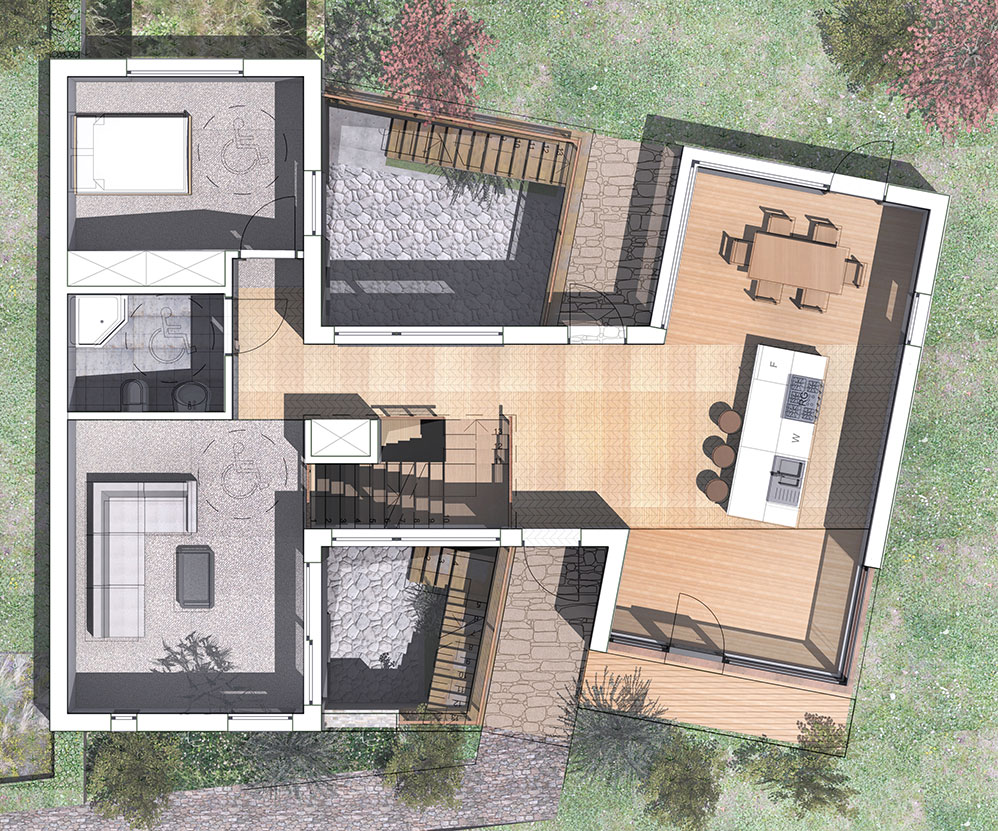
2014 House Plan in Muswell Hill

Unlocking hidden value

This blog presents a snapshot of a research programme undertaken over the Summer of 2016 that looked into the relationship between the Architects desire to create beautiful buildings and the property developers brief to maximise investments. The programme was punctuated by a series of events and publications which included dialogue and input from our clients, consultants and partners.

As a design led office with a broad portfolio of successful projects we have proved that adding design quality to a project increases the value of a development.

The text and images in the blog below were part of a publication in the form of a mapfold titled Unlocking Hidden Value. Copies of the original A2 sized document can be downloaded from HERE

1-truss_492x375
2-finc_492x375
3-col_492x375
4-que_492x375

FINDING OPPORTUNITY

London is made up of a grid of unique plots that are repeatedly reconfigured and redeveloped — that is healthy urban regeneration. Each plot requires rigorous investigation in order to exploit the specific characteristics/constraints of the site.

Good design involves a detailed analysis of existing structures, immediate boundary issues, physical relationships, infrastructure and planning policy. A detailed understanding of locality in its widest sense is considered when seeking an ideal development scenario.

Adding value through a crafted design approach that will excite and win support locally and nationally, attracts prospective users and appeals to investors.

5-hasp_492x375
6-masi_492x375
7-finc_492x375-2
8-elmc_492x375

ADAPTING THE FABRIC

As the city expands and develops, many building typologies can be imaginatively and economically adapted to new uses and occupancy.

Working in and around redundant buildings and derelict structures presents a valuable opportunity to embrace their historic structures and elements. They can be bolted on to sensitively; equally they can be slotted into or extended within the context of well-crafted new buildings. Access and circulation routes are reimagined, lightwells inserted, basements excavated, galleried storeys introduced.

9-gleb2_492x375
10-material_492x375
11-col_492x375
12-php_492x375

PUSHING THE POTENTIAL

We believe that carefully considered design creates the highest quality buildings and achieves the maximum value for the site. Optimising development potential through our designs challenges the idea that the best returns are gained through maximising the number of apartments or squeezing the last square foot out of an office or retail unit. Working with private clients, developers and landowners, we bring these values to our projects, making each of them unique.

13-hasp_492x375
14-cur_492x375
15-all-saints_492x375
16-team_492x375