We Champion Modern Methods of Construction

MMC is a broad heading that is used to define and categorise construction efficiency by transferring labour-intensive on-site construction methods to a controlled factory assembly process.

At Douglas and King we can see the advantages of MMC in all areas of a development. We embed MMC into all of our design processes spanning the full RIBA Plan of work.

The many benefits offered by Modern Systems and Construction Methods can be summarized in these key points:

Greener

Factory controlled processes reduce waste in time and materials.

Faster

Are more efficient meaning site construction time is greatly reduced.

Smarter

Ensures better construction quality management.

Safer

Eliminates on-site construction hazards

Adaptable

Factory construction allows the same level of flexibility and adaption as a site built project

What is MMC?

The UK Ministry of Housing, Communities & Local Government have published a Definition Framework that classifies 7 categories of off-site construction and spans all types of pre-manufacturing, site based materials and process innovation.

Here we outline how to take full advantage of employing the wider agenda of MMC in a development project.

1. MMC in appraisal and delivery

Development projects today require design input from many different experts. These include a core team of consultants along with various specialist reports along the way. A simplified project delivery is design led with online co-ordination and planning.

The MMC driven planning and project management systems we use chart a route though the RIBA Plan of Work stages so that everyone involved shares a common goal.  We build MMC into our Appraisal system, the backbone of our project management process from the initial stages of our appointment to client handover.

2. MMC as a design tool.

Our BIM CAD System allows us to easily balance all of the design drivers that we use to conceive and test site constraints to maximise development potential. Core consultants within a design team work on a common online CAD and data file and our clients and investors always have access to our snapshot reporting facility.

All MMC manufacturers have BIM capabilities that talk to our own computer systems. This means we are always fully engaged with industry developments including updates to product performance and specification, and greater efficiency in all areas.

We can specify adaptable factory built systems so that we can create buildings that are of the highest quality, fit for purpose and built to last.
3. MMC in Infrastructure, Ground Works and Contract Administration

Getting out of the ground is a huge challenge in any construction project. Whilst MMC systems on the market today commonly focus on above ground construction with varying levels of completion there are many MMC products and design methods we can employ in, for example, the connection of utilities, landscaping and roads and foundations and below ground structures.

Working with leading Structural, Civil, and Environmental Engineers and through BIM Software we are able to establish a co-ordinated, environmentally sound and cost-efficient construction system for the major elements of a building.  In a large part, we can include elements that are not commonly conceived to lie within the MMC package.

MMC eliminates many of the hazards that befall the construction process when on site and increases the efficiency of contract administration.

4. MMC – Onsite construction, the main systems available

We have written elsewhere about the main systems of MMC available for MMC construction along with their varying levels of completion.   See our blog

‘Transforming construction in the digital age’

Timber framed construction has been widespread in the UK building industry for thousands of years. MMC allows us to create the same structures in a better way, with all components, from insulation to surface finishes, applied in factory controlled conditions.

We work with suppliers and fabricators at an early stage so that we utilize systems that best suit the needs of a site or a building and which champion financial and environmental efficiencies.

5. MMC and the climate emergency

As owners and designers look for more sustainable designs for improved environmental impact, modular construction is inherently a natural fit. Building in a controlled environment reduces waste through avoidance upstream rather than diversion downstream. This, along with improved quality management throughout the construction process and significantly less on-site activity and disturbance, inherently promotes sustainability. High quality, sustainable, innovative, efficient, cost-effective, and shorter time to completion.

Well designed buildings benefit from a connection with the natural environment and have a minimal impact on the circular economy (i.e. they do not need to be replaced or face a major upgrade within a few years).

6. MMC as a positive outcome

As Architects and Project Managers we fully embrace the benefits of MMC to create better buildings and environments. MMC does not mean that all buildings will look the same, factory systems are infinitely adaptable and offer huge improvements to the built environment whether they are residential, public realm, or otherwise.

Through our connections with Max Farrell and the London Collective Douglas and King are currently working on a new town development within the Oxford to Cambridge Arc that is built around a National Centre of MMC Excellence. The MMC Centre will be part of the DNA of the new town and will be a place where leading manufacturers and suppliers, along with academics and designers, can showcase their technology to contractors, stake holders and to end users.

The DAK MMC Ideal House Type

Douglas and King have embraced factory and offsite construction in order to improve the quality of our buildings and environments. Working with housing developer clients, leading suppliers and offsite MMC Consultants we have evolved an ideal model house type that is adaptable to use and context.

The DAK MMC House has emerged through years of testing, exploring, engaging, measuring, listening and learning by Douglas and King, Architects and Project Managers. Every aspect of the DAK house is designed to the highest standards of sustainability and is a champion of environmental performance in construction and in use.

The DAK House Kit is authentic, adaptive and appropriate. The system is designed to adapt to a unique setting within a master plan to and reflect an authentic regional architectural inheritance – borrowing from it rather than faking it.

The DAK House can be laid out to encourage place making in a master plan and the house can be arranged to suit tenure and family type. It can also be adapted to individual tastes.

The DAK House is authentic in that it rejects the false notion of what is perceived as ‘traditional’ and instead challenges the typical housing typology offered by many house builders today.

The DAK House balances the business model with good design and achieves this through flexibility, adaptability and cost efficiency. To maximize profit solely for shareholders dividend returns in the housing sector results in the squeezing of cost/ambition/responsibility at all levels and neglects the vital component – added value.

The DAK House is built around a standard set of factory components that can be arranged in a variety of ways to suit location and use. The DAK House can be aligned to take advantage of orientation, topography and outlook, and proximity to neighbouring structures and landscape.

Manufacture and Construction

The UK Ministry of Housing, Communities & Local Government have published a Definition Framework that classifies 7 categories of off-site MMC construction and spans all types of pre-manufacturing, site based materials and process innovate

The DAK House is built with Closed Panel Timber Frame Construction which falls into Category 2 of Modern Methods of Construction. This permits all the benefits of MMC with the critical ability of adaptable design. The house type is also suitable for standard timber framed construction.

Douglas and King work with industry leading consultants BD Solutions in identifying the most realistic and efficient MMC systems to use on specific projects.

Manufacturing experts PD Solutions have collaborated with Douglas and King in the evolution of the DAK House type and our regular suppliers have developed state of the art factory facilities at the fore-front of closed panel off-site manufacturing systems.

Methodology

We plan the factory production roadmap well in advance of placing an order.  Co-ordinated drawings are passed to the worksop for confirmation of order, price, environmental credentials, and confirmation of delivery schedule.

When the price is confirmed fabrication drawings and specifications are prepared by specialist technicians within our preferred suppliers manufacturing facility and vetted and approved by Douglas and King.

Then the timber frame is produced, insulation and sheathing elements applied and smaller windows fitted. Service zones are installed within walls that will allow electricians on site to route cables and M and E systems.

The panels are fabricated as large as road transport will allow. The modular sections are delivered to site and lifted into place by crane, the whole system sitting on pre-prepared foundations and base slabs.

The panels are fixed together by the MMC Suppliers’ on-site team ready for secondary components, services fit out and internal and external finishes to be put in place by local based specialists.

Douglas and King have standard fabrication drawings and specifications for all secondary components for use in the DAK House Type and these can be sourced by other manufacturing partners or though a main contractor.

Environmental and Sustainability Targets

The DAK House champions environmental performance in construction and in use. The house type can be aligned to the standards set out in most leading standards including Passivehaus. The building type is designed in accordance with the aspirations of the RIBA 2030 Climate Challenge and the UK GBC, and meets the environmental performance targets detailed by UK Building Regulations.

We calculate the carbon footprint of all of our buildings by adding up the sums of the following impacts:

  1. impacts from material extraction and manufacturing processes
  2. transportation
  3. construction
  4. maintenance, repairs, and replacement of materials during the buildings life
  5. cycle energy and water consumption in use
  6. knock down and end-of-life recycling of materials

The best and most sustainable material for construction remains timber and this is widely used by our suppliers in their off-site construction processes.

We are committed to creating people-centered dwellings that are inclusive where full consideration has been given to the dynamics of age, lifestyle, function, circulation, level, daylight levels, insulation and well-being.

The DAK House and the DAK Development Appraisal

A design led house type development pursues the same appraisal model as would any typical development project undertaken by Douglas and King.  A design led project built around a realistic and coherent business model creates the most successful residential developments.

We assess the risk and plan the extent of investments required and the financial model for the development. We outline how to deliver the maximum development potential through design-led solutions.

We embrace the role of Design Team Project Manager in order to co-ordinate all stages of a project from conception through planning, design, construction and handover. Combining the roles of project manager and architect means we can predict and monitor the project throughout its timeline.

We collaborate closely with clients, fellow design professionals, local planners and building control officers, contractors and suppliers – all of these are valuable partners who collectively deliver the successful outcome of a project.

Join the List – the Offer

If you have a site for development and would like to know how the DAK House might fit within your development plans please contact Martin at our Shoreditch studio – martin@douglasandking.com

We will prepare a draft master plan along with a development appraisal identifying timeline, costs and all stages of the process including vision, planning, construction and occupation.

Design is King

Design is King

We design buildings that are expressive of their place and context, buildings that reflect the contemporary world.  A building must not just look right, it must feel right. It must be right.

We see the Bigger Picture

We respect the diverse characteristics of the built environment and its historic fabric.  We take a long-term view of the urban legacy we are bequeathing to future generations.

Everything is Design.

We design environments that are livable, workable and sustainable, and yet assert a subtle individuality.  We don’t want to fight for beautiful architecture.

.

In it for the Long Term

We like to work with clients who appreciate our core values and whose vision we can share.   Architecture is about respect.  Respect for clients, communities, people, places, craftsmanship, the planet.

.

Our Culture Breeds Creativity

We design buildings that create conversations not controversy.  We embrace the latest construction technology and the possibilities and solutions it presents.  During the early stages of a project we concentrate on information gathering and this provides a platform for the concept and brief.

We are Natural Collaborators

We collaborate closely with clients, fellow design professionals, local planners and building control officers, contractors and suppliers – all of whom are valuable partners that collectively deliver successful outcomes.

Architecture Pushes Profits

As an added benefit we research and provide you with a comprehensive development appraisal that considers the potential outcomes, risks and capital requirements.  We have an enviable record of achieving difficult planning consents.

Time to turn the tide on Noddy houses

Part 1 – The Post Modern Default

Douglas and King are currently involved in the design of new homes in partnership with forward thinking house builders. This article forms part of a wider investigation within the practice that examines the key issues of design authenticity – identity, cost, place-making and the creation of credible neighbourhoods.

In this article we challenge the typical housing typology offered by many house builders today and how this model can be improved upon to create authentic responsive homes.

For many there is a pre-conceived notion of what a traditional house looks like, we can see this evidenced when we ask a child to draw the image of a house. This notion has its origins in the house building projects of the early 20th Century when, as a reaction to the terraced urban slums in industrialised cities, the architects of that time tried to replicate the typologies of medieval and pre-industrial buildings in the creation of new towns and suburbs. These new house types were built with the technologies prevalent at the time, mass-produced load bearing masonry, and so the buildings were, in reality, very different to the historic models.

Since then the understanding of what traditional architecture is has changed. Traditional Architecture has become a multitude of styles and trends including terraced, semi-detached, pre-fabricated, bungalows, town houses, etc, etc.

Developers and house builders are likely to draw on historic house styles or brick-built box typologies often assuming that potential occupiers will feel safe with these genres.   What this suggests is that these ‘traditional’ house styles have an enduring appeal that guarantees success for the development.

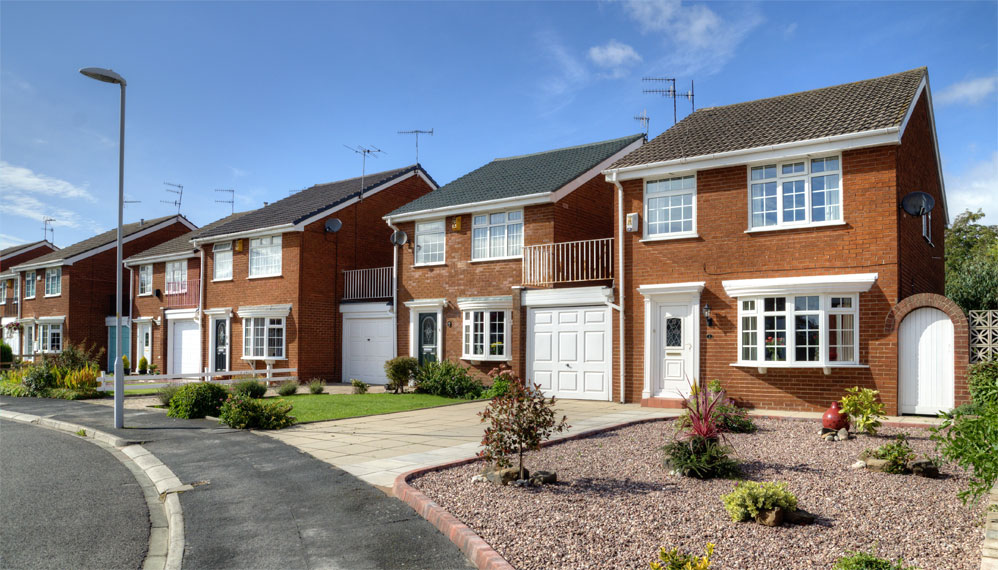
The image above is typical of a new house type that is often championed by private developers.  A few observations reveal a number of shortfalls:

1. Houses are generally not orientated to optimise what can be achieved by topography, outlook, sunlight and daylight provision at different times of the day, insulation, winter wind factors

2. The traditional features are not drawn from a local vernacular but from a preconceived notion of what a ‘traditional house’ might have looked like

3. Windows and doors are downsized and not positioned to maximise outlook or the amount of daylight that can enter the building

4. The architectural features are an eclectic composition of different types. For example the entrance porch is from an agricultural building, the chimney is a fake, the gable ends are from a post-industrial architectural language and the dormer windows at first floor level are out of context.

5. In order to reduce costs and in part due to the lack of available craft components, the brickwork of the exterior is either bland or poorly patterned in order to add complexity to what would otherwise be a featureless exterior.

6. The building is likely to have been constructed by a system building process i.e. an offsite construction system such as pre-assembled timber frame in order to reduce building costs. The building suggests that it is of a loadbearing masonry construction – it is not

7. Internal and external facias, rainwater pipes and other secondary components are camouflaged plastic

8. The plan of this building does not allow for adaptability or flexibility. The ceiling heights and room sizes have been drawn up to conform to the minimum standards allowable under the building regulations

9. All houses in the 21st century are built with modern technology whether they are dressed and decorated with historic style references in order to create a safe, recognisable language to the building or whether they are built as an honest response to the vernacular architecture of the region.

10. Running parallel is the maxim that many developers use when planning a new ‘estate’ of houses.  Maximise the development potential by squeezing as many units as possible into a plot of land to the extent that it looks like a ‘barracks’ and simultaneously present the prospective purchaser with little or no diversity.

11. Maximising the flow of natural light through orientation, a relationship with the landscape, privacy and community interaction are not priorities.  Behind ‘fake’ facades the ceiling heights are of the minimum standard set out in the Local Plan, doors and other internal finishes are of an acceptable quality (just about) and kitchens/bathrooms are typically standardised.

12. It is often not a priority to respect to endorse the fundamental principles that to create a credible and functioning community it is essential to design for the long term, for mixed occupancy, an authentic sense of community and the changing narrative of a family and street.

Whilst we continue to discuss the key drivers of successful housing elsewhere, it is worthwhile flagging up a seemingly simple question, but one that is often asked:

“can we have a traditional house…… or can we have a modern one or both?”

It’s actually a very difficult question to answer against a backdrop of what are essentially pre-conceived and over-simplistic ideas of what ‘traditional’ or ‘modern’ architecture actually is. Below we try to throw some light on these within the context of a broader and important issue – ‘authenticity’:

1.  all buildings built today are modern as a result of the technologies and materials used in the construction process

2. a modern building can have an authentic historical theme, what architects call a Genius Loci or ‘spirit of place’

3. well-designed buildings are highly functional, energy efficient, maximise the daylight orientation and give a higher level of user satisfaction than historic re-interpretations

4. authentic modern buildings that reflect a local architectural language will use substantial elements of factory construction and therefore yield the best value for money in terms of building costs

5. authentic modern buildings will find favour with prospective buyers when their aesthetic quality is marketed positively resulting in superior sales to a fake attempt at a historic architectural language

6. modern family living requires homes that are flexible and adaptable beyond one or two generations

7. Authentic architecture is responsive to the environment and to sustaining it

For many the notion of ‘modern architecture’ brings to mind cold, unwelcoming buildings with hard edges and straight lines. This view is largely encouraged by the ‘brutalist’ buildings of the mid-20th century that attempted to proclaim in a new way the artistic principles of form aligned with texture, materials and spatial arrangements.

The exemplars of this ‘brutalist’ building style are now buildings listed for their architectural merit as examples of the International Modern Movement.  Unfortunately, the UK largely passed this by with a few honourable exceptions.

What went wrong, and further compounds the mis-reading of this style, were the poor interpretations of this architectural language in the creation of low cost and mass housing in the ‘50’s, 60’s and 70’s.   These interpretations were adversaries to the movement and their legacy lingers on.

1931. Villa Savoye, Poissy, France by Le Corbusier
1949. The Eames House, California.

The notion of ‘traditional architecture’ when applied to housing is almost always perceived as it is interpreted by mainstream developers and house builders.  It can be neo-classical, country house, cottage style, or a hybrid of them all – whatever the resulting ‘design’ the house will be ‘modern architecture’.   Architects call this interpretation of traditional architecture the ‘post modern’ and the greatest myth is that ‘post modern’ homes are the preference of potential occupants.

These typologies are rapidly being built all over the UK as part of the response to the national housing shortage.  Invariably, they represent a missed opportunity to create high quality homes that are both respectful to their location and its history but also to the aspirations of the people who will live in them.  All too often developments of 120 houses or more maximise density without acknowledging the need for homes and neighbours to have a respectful distance between them as well as a meaningful relationship with each other and to the landscape in which they are being built.

In another article we discuss the importance of ‘place-making’ and how it must be considered as a primary factor when planning volume new-build housing schemes.

post-modern-housing-998x570


Part 2 – Investing in the Design Process – Positive Partnerships – Authenticity and Diversity.

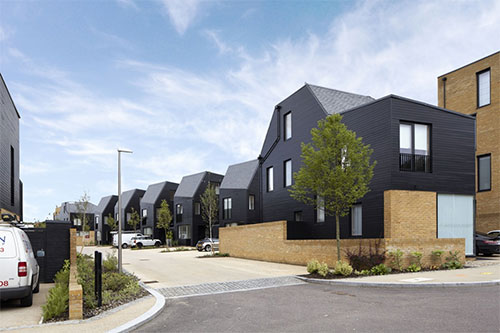
There are exemplary examples of recent new housing developments where a full awareness of the local vernacular is employed to create modern homes that interpret a traditional architectural language. It should be said that homebuilders, including those behind some of the housing typologies outlined above, are making some efforts to improve the quality and design authenticity of their model.  The 2020 Open Design Competition was an initiative by Taylor Wimpey and the RIBA find a more appropriate model for the aesthetic house style and plan.  All the shortlisted proposals were for buildings that were adaptable, responsive to their location, were nuanced in their relationship to each other and considered the living experience of the occupants. The image below is of the winning entry by Openstudio Architects.

Openstudio Architects winning entry for the 2020 Open Design Competion


Examples of Authentic Vernacular House Building Projects

Below are further examples of authentic housing which exemplify the ways in which the vernacular architecture of an area can be ‘borrowed’ rather than ‘faked’.  These have all been commissioned by mainstream house developers and demonstrate the ways in which an intrinsic ‘sense of place’ can be at the heart of the development.

Abode. Proctor and Matthews Architets
Newhall BE. Alison Brooks Architects
Horsted Park. Proctor and Matthews Architects
St Chads, Kent. Bell Phillips Architects
Beeld Effekt and Karres Brands
Carrowbreck Meadow. Hamson Barrow Smith
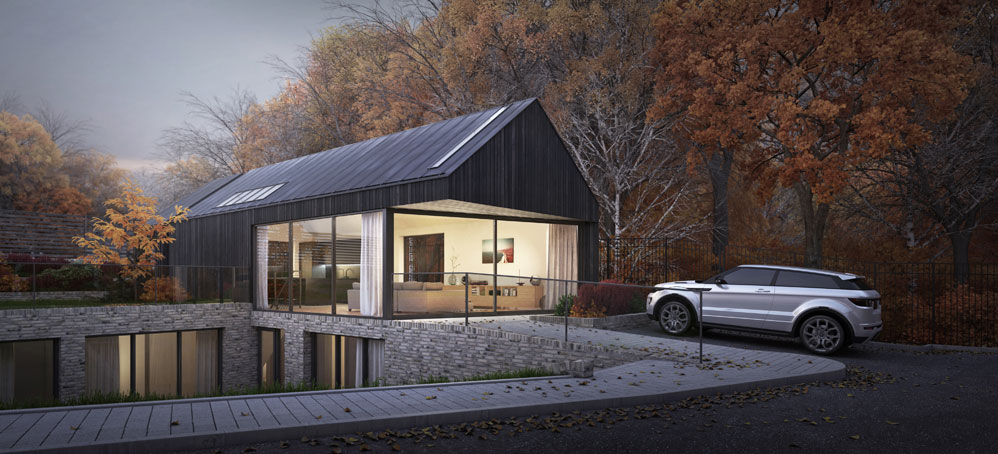
House in an Urban Woodland. Douglas and King Architects
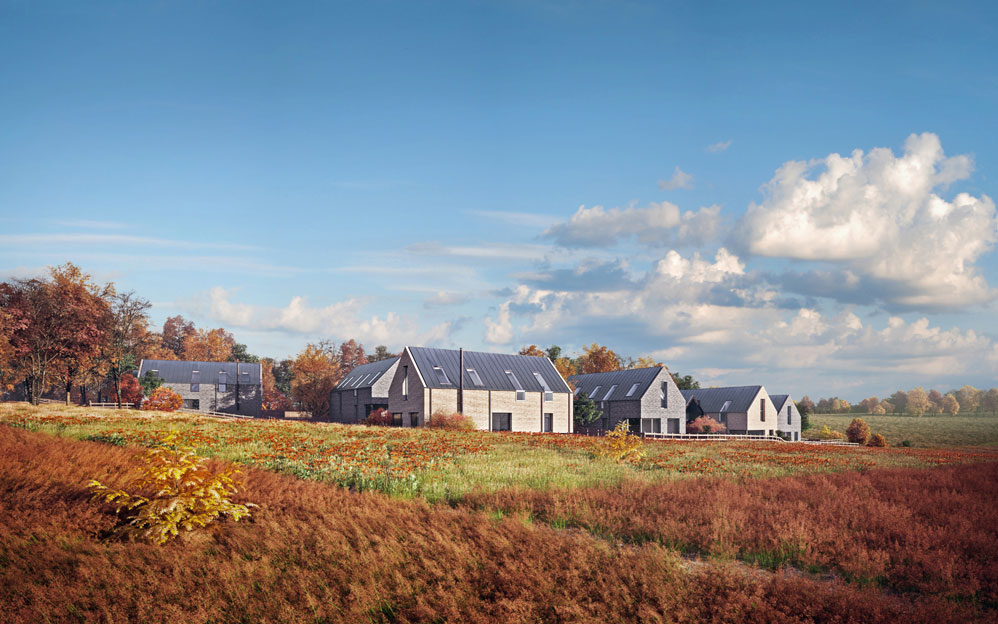
New hamlet in Hertfordshire by Douglas and King Architects
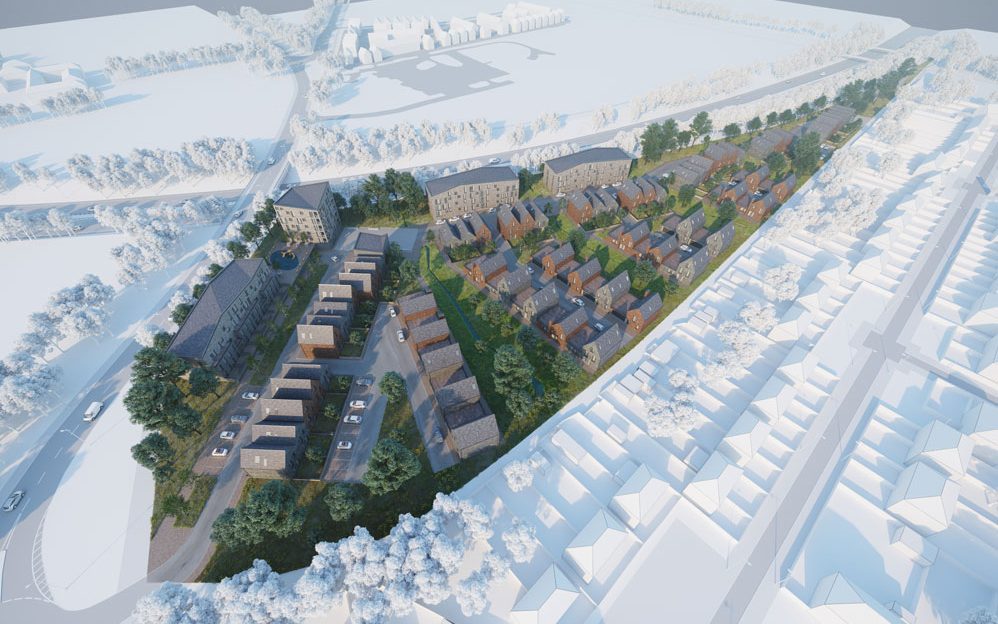
New Town Extension in Essex by Douglas and King Architects

House in an Urban Woodland and other Authentic Projects by Douglas and King Architects

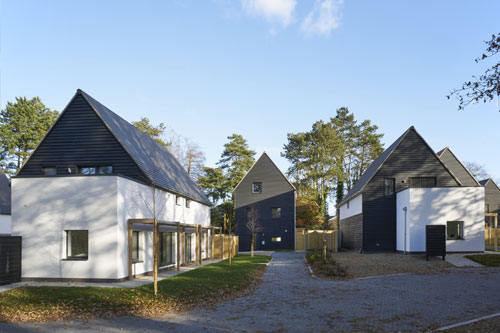
Our own example of the Authentic approach, ‘house in an urban woodland’, is one of a number of new houses built by the practice where the topography and setting influences the design and style of the dwelling.

These contemporary homes are the outcome of a design process that considers the historic building ‘language’ of the areas in which they are built. Whilst the style of these developments is unashamedly modern, the homes employ natural and local materials in a far more effective and inviting way than the ‘post modern’ response.

The density of these developments has been calculated through a process of evaluation and sensitive planning – the questions we ask ourselves are how will each home relate to its neighbour and how appealing will the new neighbourhood be to its residents and why?


Part 3 – Conclusion

A successful design in any form of building type is measured by the enjoyment of its occupant(s) and their response to its environment and aesthetic.

In designing homes there is a strong argument for an authentic approach and the key aspects of this are as follows:

1. They are designed to reflect the local architectural heritage

2. Employ a common set of components to keep costs down but are arranged in a unique way to respond to their setting within a site and their occupancy

3. They are adaptable and flexible

4. They are not inappropriately decorated

5. Their exteriors are finished in high quality materials such as timber cladding or textured brickwork

6. They have a respectful distance between neighbouring homes and a meaningful relationship to the landscape in which they are being built

Further Reading

FR-The-Observer---Rowan-Moore

Click Image to Link to Article:

An excellent article by Rowan Moore looking at the importance of good design in the provision of New Homes in which he states:

‘Much of the credit should go to a quietly heroic generation of architects. These have grown up in the era following the backlash against their profession, when they could take nothing for granted, when they had to prove again and again that their ideas were not the fantasies of arrogant dreamers, but honest efforts to improve the quality of the lives of future residents. They sometimes find themselves among the worst-paid and hardest-working around the tables of consultants who nowadays get buildings built, and the most committed to the social benefits of the final product. They tend to get squeezed between those well-intentioned regulations and the merciless spreadsheets that calculate profitability and market demands, looking in narrow margins for ways to elevate homes above the basic.

But the greater danger is that the fragile flowering of good housing is crushed by the forces of expediency against which it is constantly struggling. It has been, for example, strengthened by support from a planning system which is now being progressively undermined. And there are plenty of examples to show how much worse things could be: airless, badly planned living capsules stacked high and wrapped in multicoloured aluminium panels, or the continuing output of Noddy houses which, like cockroaches, never go away.’

Sustainability in our DNA

At Douglas and King we champion sustainability in all of our developments. To be truly effective, sustainable design requires a holistic approach to a whole range of issues from social engineering to construction impact. A viable approach to sustainable design requires sustainability to be engrained into the DNA of all design possesses and development decisions.

In architecture, this decrees a responsible approach to all aspects of development to create a positive future for all. Sustainability is not just about conserving our planet’s resources but also about creating places that encourage successful communities and whose life span endures beyond a generation. We work to create low impact developments that eliminate pollution and minimize environmental and climate damage.

Our projects are exemplars in sustainability because we set standards through example. Our track record proves that that sustainable developments can be economically viable and engender a positive legacy for future generations.

We are an RIBA Chartered Practice. Our Environmental Policy is fully compliant with the guidelines set out in the RIBA’s Chartered Practice Environmental Policy Guide.

RIBA 2030 Climate Challenge

As a Chartered Practice, Douglas and King have signed up to the RIBA 2030 Climate Challenge Checklist. The policy sets out the actions the practice is taking to set standards for meeting the need to limit global temperatures below a 1.5°C rise.

Focused Knowledge

As Design Team Leaders we run annual focus groups to ensure that our own and wider team members are implementing sustainable design. For our 2020 programme we shall be hosting seminars, writing research papers and highlighting our knowledge on live projects. Our programme includes presentations from guest experts and fellow consultants, visits and studies of exemplar projects, and attending lectures given by The Building Research Establishment and other relevant bodies.

Focus Areas for 2020  Include

Creating Sustainable and Aspirational Social Environments

Aspirational Homes are Sustainable

Sustainable Drainage and the Natural World

Innovation and Technology that Limits Emmisions and Energy Use

Sustainability and The Experts

Kintsugi and Re-Inventing Existing Buildings

1. Creating Sustainable and Aspirational Social Environments

Placemaking is the tool by which we encourage sustainable developments and communities. Our placemaking blog provides a lot of detail on our principles and approach.

Whether we are designing 3 houses or 300 we consider who will live in the homes we create and how they will interact with each other and their environment.

We design inclusively and holistically in order to create positive social impact through our developments.

Example Projects with Placemaking at their Core

This project creates hundreds of new homes in Essex within a placemaking context. The construction phase is low carbon because we are using offsite timber framed construction methods. Our master plan for this new community is socially inclusive and facilitates communal interaction through shared common spaces and public transportation.

This is one of our suburban densification projects and aligns with the Mayor of London’s New London Plan. Here we are achieving a 38.4% improvement upon the requirements of Part L of the Building Regulations relating to carbon emissions. The development is an example of how a brownfield site can be re-imagined, create much needed new homes, and provide a robust and long life balance

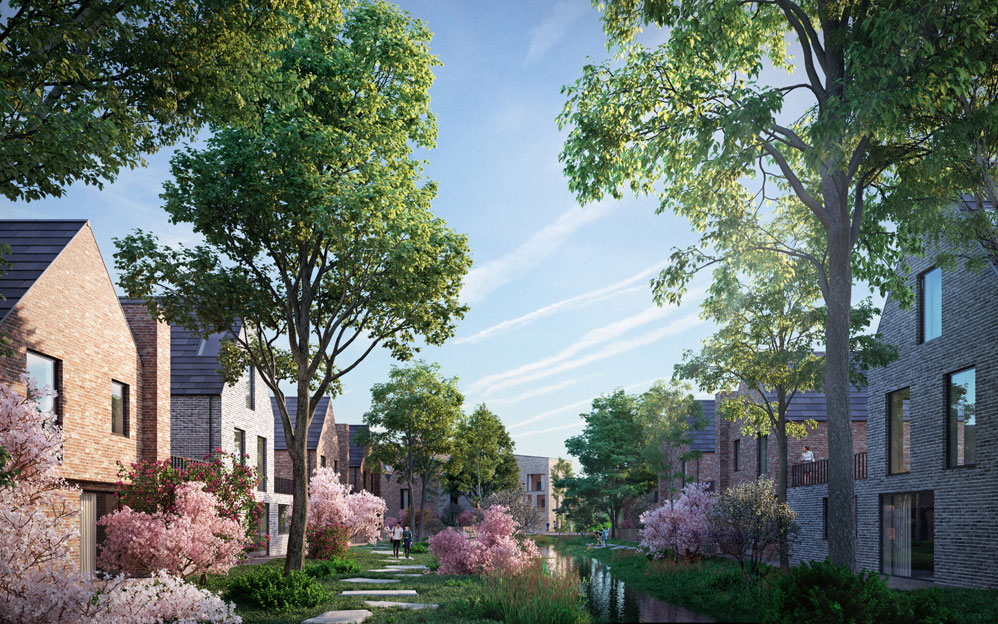
In this project we are designing new family homes around a copse in the Hertfordshire landscape. This small new community will have a low carbon footprint including a sustainable drainage system. The rural environment is central to the community spirit we are creating and our landscaping design reflects this

2. Aspirational Homes are Sustainable

The design of successful homes requires an understanding of practical issues of lifestyle, it is important to create unique and inspiring spaces that are flooded with daylight during the day and are warm and safe at night.  We design buildings of architectural excellence designed to create a sense of belonging for their owners and the ability to be fully integrated and identified with their specific site.

Example Projects set to Inspire

We design houses that are unique to their location and use. House in an Urban Woodland demonstrates our approach to create a contemporary family home and how we design in a way that allows the client to develop a strong emotional bond with their home.  We listen to our clients, to hear how they wish to inhabit their home, and develop our design accordingly.  We ensure that the design makes the best use of orientation and the natural features of the site including sun, wind and landscape.

This project was shortlisted by the Architects Journal for the award category of the best residential development in the UK built during the last year with a construction budget under £10m.

The form of the building suggests an architectural conversation between the neighbouring listed Church and the area’s mansion block typologies. The grid of the windows emulates the proportions of both and re-interprets them in a modern way to give expansive views of the immediate surroundings and creating light filled interiors within.

This is a robust concrete and masonry building that will last and look good for a very long time. It is about a permanence of architecture, built in a traditional way in an historic context, yet with an unashamedly modern aesthetic.

External/internal wall insulation was inserted to a gauge of 150 mm, an unusually generous degree, and the flat roof of the building is wrapped in solar panels to provide an alternative and supplementary energy source.

3. Sustainable Drainage and the Natural World.

Why is it you can build in Holland at all when the whole of the Netherland is located in a flood zone?

It is argued that building within flood zones is not sustainable due to rising flood levels and frequency through climate change.

Our landscape is constantly changing and rivers and low lands are are more threat than ever before from flooding. Local Councils and the Environment Agency are trying to meet the challenge faced with large civil engineering flood defence programmes. At Douglas and King we design our flood risk contingency at the concept stage of every project. We consider the viability of creating onsite flood barriers or whether to build beams into the landscaping to elevate the ground floor levels of the structures.  In all cases we aim to achieve a higher than 1 in 100 year climate change flood risk level.

There are exemplary projects throughout the world that have met the challenges of building on flood zones and we are constantly learning from the techniques employed and their effectiveness as part of our ongoing sustainability strategy.

Example Projects that live Above the Water

Our project creating five new family houses on the riverside in Buckinhamshire is one of several projects that are built within a flood zone as designated by the Environment Agency.

We have worked with specialist Engineers to set the ground levels of the builings above the 1 in 100 year Climate Change floor level. Each dwelling is designed with an undercroft to take any flood water away from habitable space, the flood level being calculated through extensive survey and investiagetion both upstream and downstream.

These homes have ground floor levels set 1.1m above the surrounding terrain, well above the average river level.

4. Innovation and Technology that Limits Emissions and Energy Use.

As construction technology is constantly changing and evolving therefore we need to keep in step as to how we best approach and implement sustainability practices in current construction procedures.  It is critically important that we as Architects understand the environmental impacts of the materials we specify.

For example, concrete manufacture creates 10% of global greenhouse gas emissions. Today, in order to reduce the environmental impact of using pure concrete, the specification could replace 30% of the cement in a concrete mix with PFA Fly Ash, or replace 70% of the cement in a mix with GGBS or blast furnace slag, both of which reduce the amount of cement used and also add strength. Both PFA and GGBS are waste products from coal-fired power stations and blast furnaces both of which are currently being fazed out, however there is a 30-40 year stockpile in the UK alone.

Structural steelwork has a better environmental footprint. The initial excavation and production is very costly to the environment but it is a material that is easily recyclable so scores very well in lifecycle points.

However, the best and most sustainable material for construction remains timber and this is widely used in off-site construction processes.

We also keep a close eye on developments in the following key areas:

On Site Renewable Energy Sources: Wind / Ground and Air Source / Solar / Hydro

Carbon Footprint of Materials with a strong support for timber in construction methods

Heat recovery and cooling – MVHR and Cross Ventilation

Encouraging landscape and ecological values

Projects with a the Highest Standards in Low Environmental Impact

Our proposed Picture House in Shoreditch is designed with a BREEAM Excellent rating which is the highest standard for minimal environmental impact of a building of this type. The facades are designed to create solar shading and materials have been selected to minimise the carbon footprint of the entire construction process.

5. Sustainability and The Experts.

To maintain our sustainability aspirations and to deliver the best possible solutions we employ specialist Environmental and MEP consultants as core team members from the very beginning of our projects planning. From the conceptual stage to user handover their expertise and advice leads our design sustainability values.

Our Core Environmental Expert Partners are

There are a number of regulatory and benchmark organisations and standards that we work to and with depending on the type, scale, occupancy needs and location of a project.

Passivehaus

Passivhaus is a voluntary standard for energy efficiency in a building, which reduces the building’s ecological footprint. It results in ultra-low energy buildings that require very little conventional energy sources for space heating or cooling. Our new homes in Dorney Reach aim to achieve Passivehaus accreditation.

Passivhaus buildings require little energy to maintain a constant pleasant temperature, due to excellent insulation, air tightness and efficient heat recovery systems. This means that these buildings can easily be powered by renewable energy sources such as solar panels and heat pumps. Sustainable constructions are therefore a very attractive option for residents and homeowners as they drastically cut energy bills and help to lower the carbon footprint. Passivhaus energy bills are slashed by typically 90% – that can mean a saving of several hundred pounds per year. For example, energy bills for a 3 bedroom house can be as little as £100 per year.

This type of sustainable construction is also a wise choice for social housing projects, as tenants will have considerably lower heating bills.

Code for Sustainable Homes and the Building Regulations

The Code for Sustainable Homes (the Code) was an environmental assessment method for rating and certifying the performance of new homes. The Code  brought about a step change in applying targets to sustainable development. In its time it set a national standard for the design and construction of new homes with a view to encouraging continuous improvement in sustainable home building.

In 2015 it was replaced by optional Building Regulations which set guidelines for various services and supplies, eg water and access, along with a new national space standard. The optional regulatory standards are comparable with the requirements for the former Code for Sustainable Homes Level 4 and are often a requirement for planning permission to be granted.

BREEAM

BREEAM is an international sustainability assessment method for the master planning of projects, infrastructure and buildings. It recognises and reflects the value in higher performing assets across the built environment lifecycle, from new construction to in-use and refurbishment.

Our commercial projects in London are all BREEAM rated and the Picture House and Titchfield House, both commercial developments have been rated ‘Excellent’.

LEED

Leadership in Energy and Environmental Design is the most widely used green building rating system in the world. Available for virtually all building, community and home project types, LEED provides a framework to create healthy, highly efficient and cost-saving green buildings

Our commercial projects in London are all BREEAM rated and the Picture House and Titchfield House, both commercial developments have been rated ‘Excellent’.

BIM Level 2 – Including Lifecycle Impact

BIM or Building Information Modelling enables 21st Century architects and designers to significantly improve energy performance and stimulates  innovative ways of delivery and operation. Sustainability assessments can be built into BIM and it is a compulsory component of all public sector building commissions.

In terms of research there are thousands of scientists working on this most important and pressing issue and here we list a few of the specialist bodies/regulations that we work with or refer to regularly.

Transforming construction in the digital age

In this article we describe some of the factory building systems that are widely used in the construction industry throughout the UK today. Modern methods of construction employ a radically different approach to that of the past and minimise the on-site activity. They offer many advantages in terms of shortening construction schedules, a greater degree of predictability in cost, reduced material waste, reduced carbon emissions and greater safety and security on site.

The process of off-site construction involves planning, designing, fabricating, transporting and assembling building elements for rapid site assembly to a greater degree of finish than in the traditional piecemeal on-site construction processes.

We have explained elsewhere that the urgent need for more homes stretches back to the 19th Century when industrialisation drove a huge rise in population. We have explained how historically it was the new technology of the age that enabled the creation of the mass housing projects of those times.

Today, as we live in a digital age we have developed building systems that allow us to create high quality houses at a comparatively low cost though computer aided design and off-site construction. In our article ‘Designing Homes, The Argument for an Authentic Approach’ we explain how authentic buildings can be created with timber frame and other modern methods of construction.

In this discussion we look at the factory built systems that are readily available and why these methods, when coupled with a place-making strategy, can create authentic, successful vernacular houses that are fit for contemporary lifestyles.

Factory-Image-998x421

Part 1 – Construction Systems in Timber

Timber has been used in the construction of buildings for thousands of years. The main building construction method shifted from timber frame to load bearing masonry at the time of the industrial revolution when bricks, blocks and other building materials were first mass produced. Today’s advances in technology and manufacturing has re-introduced timber construction as the main structural component in house building.

Timber is the central material in off-site construction and as it is a renewable, low carbon material it offers a number of different options within the factory production process. We describe some of these options below.

Timber Frame Construction

Timber frame is probably the most commonly employed off-site construction system in the UK. Walls, floors and roof panels are assembled as cassettes by computer controlled production facilities. This computerised process allows each component to be unique and introducing variety to the design palette i.e. each individual dwelling can be designed to match the needs of its occupants and to its context in the landscape.Cassettes can either be Open or Closed Panels. Open Panel cassettes are simply timber frame structures whereas Closed Panel Cassettes involve a greater level of completion with the factory installation of windows, apertures for services, breather membranes etc.

Timber-Frame-Construction-998x611

Oak Frame Construction

Oak frame construction involves the factory fabrication of large oak frames that are delivered to site to be fixed in place. Oak frames can be incorporated into the buildings in a number of ways and can be assembled with SIPS panel infills as described below.Oak frames are popular in self-build projects because they offer speed of construction coupled with the historic and authentic method of construction. They also offer a natural aesthetic if the building fabric is to be used as a external feature.

Oak-Frame-Construction998x749

Cross Laminated Timber

CLT is a structural laminated timber panel system that is used to create solid timber walls, roof and floor panels. CLT is produced by gluing laminates two ways and by finger jointing soft wood in layers that are set at 90 degrees to each other.

CLT is a very successful construction process as it has a high loadbearing capacity, and high levels of acoustic, fire and structural performance. CLT is used in most building types and is popular among architects particularly for its beautiful aesthetic appearance.

CLT-998x749

Part 2 – Volumetric or Modular Systems

Volumetric construction involves the full fabrication of large components that are delivered to site. An entire house can be built from just a few modules that, when delivered to site, require no more than light finishing and decorating once assembled.

Factory production of such large components that are delivered complete with fixtures and fittings means that there are very few defects in the completed building. The main advantage of Modular Construction is the speed of assembly with houses completed within days.

Volumetric construction does not mean that every component must be identical. Computer controlled construction in factory conditions allows for flexibility and variety in building forms and material finishes. Architects use BIM 3D computer programmes that work hand in hand with manufacturing technology to deliver buildings that are responsive to their location and occupation.

Volumetric-998s561

Part 3 – Structurally Insulated Panel System (SIPS)

The SIPS system provides completed cassettes with oriented strand boards (OSB) and a full polyurethane or expanded polystyrene insulation.

SIPS panels are widely used in house building. They provide components that do not require any other form of structural support, offer high levels of insulation and can be rendered fully air tight at the point of assembly.

Sips-Panel-Construction-998x749

Part 4 – Lightweight Steel Frame Construction

Lightweight steel frame construction is becoming increasingly popular in the UK. Lightweight loadbearing galvanised steel frames are factory assembled and fixed together on site to create the structural envelope of a building.

Steel frames are dimensionally accurate, embody a very high strength to weight ratio, have longevity, and are adaptable and fully recyclable.

The benefits of lightweight steel construction are similar to those of timber construction. The high strength characteristics of steel reduce the size of structural members and spans can be increased without the need for additional supports. Less structure offers more room for insulation and finishes, steel framed buildings can be highly energy efficient in use.

Lightweight-Steel-998x749

Teamwork makes the dream work

Douglas and King grew up in Shoreditch, a formerly semi-derelict and leftover backwater which has undergone a successful culture led urban regeneration programme. As a consequence the practice has built a large portfolio of completed design led projects. Our early clients were not developers, investors or banks but were laypeople and owners of underdeveloped or semi derelict properties. People of little or no development experience whatsoever and who need to be guided through a very complex process in terms of planning, construction, and occupation. We had no choice but to lead the projects from the front, this meant employing the RIBA Plan of Work and managing the projects from start to finish around a sound and credible business model.

Today, the result is that we are a Design Led office that is not frightened of leadership or commitment at all stages. We predict opportunities, design great buildings, and environments and know how to build and inspire everyone involved in a project. We understand how to get the best out of large teams. We have lived through a regeneration boom, the delivery processes we have evolved and deployed have upscaled and been implemented structuring projects throughout London and the wider UK.

There has been a lot of debate in the media recently about Project Management and the role of the Architect.

At Douglas and King we lead the project from inception with the aim of adding value through design and management excellence. We work closely with our clients and co-ordinate and collaborate with other professionals. We ensure our projects are fully and appropriately resourced and, as Chartered Architects, we are supported in all our undertakings by the RIBA. We have an extensive portfolio of completed and ongoing projects, all of which have been or are design led, solution focused and action oriented.  All our projects are structured around an Architects Development Appraisal.

The Architects Development Appraisal is written at the outset of a project and is the tool by which we set out the project brief, structure, design criteria and financial expectation.  The Appraisal is the key aid to a successful project management strategy and through its use throughout the timeline of the project it enables the essential aspects of monitoring and evaluation, reporting and cost control.

The Appraisal format that we use at Douglas and King is the mechanism by which long term aspirations are kept clearly in sight throughout the various twists and turns that a project make take during the course of its development and realisation.

The key components of our development appraisals are:

1. The Executive Summary
Development Appraisals are working documents and are regularly updated. Each revision/update is covered by an executive summary explaining the key features since the last revision..

2. The Delivery Programme
All projects are structured around the RIBA Plan of Work which runs from Stage 1 (Strategic Definition) to Stage 7 (in Use). It is important to explain the sequencing of the Plan of Work by identifying the stages within the project development and to tailor the Plan of Work to individual projects. The Appraisal is updated regularly and the Delivery Programme runs in parallel with the Appraisal, indicating the progression of each stage  alongside the overall programme.

3. Critical Path Analysis
The critical path analysis explains in diagrammatic form the various paths that need to be followed to achieve key milestones. Each path sets out the various components that need to be synchronised in order for these milestones to be accomplished.

4. The Areas Schedule
The areas schedule sets out the Architects understanding of the development potential of the site in terms of floor areas.

5. Assessment of Construction Costs
Construction costs are the domain of the Quantity Surveyor. We work closely with a Quantity Surveyor to ensure that the implications of Architectural decisions are fully articulated and understood in terms of cost and complexity.

6. Assessment of Delivery Costs
Working with a Quantity Surveyor is the safeguarding system by which the delivery costs are predicted, confirmed, and tracked. The Appraisal sets out the professional team’s input by discipline and quantifies their individual fees, the requirements and cost of specific surveys and specialist reports, CIL tax, local authority and other submission expenses, and any other costs not associated with the purchase of a site or the construction contract.

Therefore a complete cost-tracking schedule is incorporated into the Appraisal and this is updated monthly in order to monitor all professional fee claims against agreed appointments. Whilst all appointments within the project are made directly with our clients, the individual and master work-flow and fee draw-downs, etc are regularly monitored by the Architect.

7. Assessment of GDV and Yield Cost
We provide information to our clients and also commercial agents within the professional team in order that the value of the completed project can be predicted. As market conditions change it is important that the GDV and Yield expections are regularly re-appraised against current market conditions.

8. Financial Summary
The financial summary reviews the development costs against the ultimate yield or GDV.

9. Consultant Reports
Each month we ask consultants to write a very brief statement for inclusion in the Development Appraisal. Their report is indicative of their individual progress within the Plan of Work and to the advancement of the key milestones.

The Development Appraisal is therefore a live document from project outset to completion that continuously tracks and indicates the health of a project.

Examples of Projects where Douglas and King Architects act as Design Leader, Co-ordinating Consultant and Project Manager..

FAQs – Frequently Asked Questions

Lego-Questions-998x418

Q. Architects have a bit of a reputation for being unreliable in managing project budgets i.e. cost over runs?
A. Quantity Surveyors are experts in the managing of costs relating to building projects.  It is a key appointment and should be made at the earliest possible opportunity in order to work with the Architect in structuring, monitoring and controlling the financial aspects of a project while still achieving the required quality and standard..

Q. If Architects are so instrumental in producing and monitoring the Development Appraisal why are Architects reluctant to call themselves Project Managers?
A. The role of the Architect is by definition that of a Project Manager. The Architect’s ambition is driven by the desire to deliver a project of design quality within the given development criteria. The term, Project Manager, suggests that projects are simply driven by process.

Q. Why is an Architect the Co-ordinating Consultant and not a Project Manager.
A. Architects are the Co-ordinating Consultant, information from all other consultants and agents are assembled, checked and included in the Architects drawings and specifications. In addition to this co-ordinating role the Architect is the only member of the consultant team that has a close involvement with the project from start to finish. On large or complex projects it is sometimes a client preference to employ a Project Manager to measure and monitor progress, however the Architect remains the Project Leader and Co-ordinator.

Q. Why is the project not led by different professionals dependant on the stage of a project?
A. Continuity, connectivity, comprehending the bigger picture. information exchange abilities, collaboration, know-how and financial acumen – all of these qualities lie within the realm of the Architect.

A dictatorial style of leadership works as poorly in Project Management as it does in Personnel Management. The key to the success in either field is the collaborative spirit through which the team communicates, co-ordinates and thrives.

Humane Housing with a mix of Social and Market Yield

Let’s Share the Vision

Here we explain why Douglas and King, as architects, believe that housing serves a fundamental human and social need.  We believe that incisive knowledge and insightful management of the dynamics of integrating Affordable Housing and For Profit housing can maximize investment value.

We advocate responsible real estate strategies that create positive social impact alongside strongly performing investment models.  We understand the importance of the sustainability of an asset and yet within this model create aspirational communities.

We are experts in managing the financial model of a project at all stages and are 100% happy with a profit driven motive.  However ‘maximising profits’ at the expense of delivering good quality buildings and community focused environments is at worst anti-social and at best discriminatory. A good investment strategy must incorporate environmental and social issues alongside traditional economic considerations.

We as architects strive to create the best possible solution for the people that will live in the developments we design yet are equally committed to ensure that the funding partners receive resilient profits on their investments.  Responsible investment requires anticipating and managing all risks to maximize returns, not only the absolute but also the anticipatory.

The Role of Housing Initiatives

In order to alleviate lack of provision and high values in the housing market national planning legislation is undergoing re-evaluation to encourage an increase in homebuilding.  The new legislation is intended to ensure that private sector new housing delivery provides for all members of our society from the affluent to the impoverished and from the old to the young.

There are also initiatives to increase the supply of social and affordable housing including that of consent to Local Authorities to again develop their own estates. Here we explain why, as architects and project managers, we are placed centrally between the ambition of a development investment model and the ambition to create a successful and well-balanced community.

We welcome legislation that encourages the creation of mixed communities and that is why we encourage developments with place making at their core.  This aim yields a twofold outcome: mixed tenure helps integrate people and cultures, stimulates opportunities and creates a neighbourhood that has potential.  It also encourages an entrepreneurial vision that can be shared by institutions, not for profit partners, and the financial sector.

Since the 1980s the cost and types of housing development have been driven by prevailing market forces.  Developments needing to prove that a profit can be made in order to attract private sector investment. The issue here is that there has been little control over the balance between market yield and investment in successful communities.

The Role of Developers – The Good, The Bad and the Ugly.

There are many development players and partners in the housing sector.  Some are massive profit-driven entities, e.g. Persimmon (the Ugly), some are ideas shapers, e.g. Igloo (the Good), and some are just plain Bad (unameable).  The Good strive to deliver an effective social balance of quality homes and inclusive communities within a robust and strongly performing investment model.

To maximize profit solely for shareholders dividend returns in the housing sector results in the squeezing of cost/ambition/responsibility at all levels and neglects the vital component – added value.  The profit net gain/loss might be determined by many factors that may include the following:

The availability and purchase price of the land for development

The cost of the infrastructure necessary to support a new development, e.g. onsite roads, sustainable drainage, utility connections, public transport and amenities, etc

The cost of construction including buildings and landscaping

Fees for specialist advice and design team costs (Architect, Engineers, Agents, Solicitors) etc.

The cost of taxes and other contributions that may be part of the planning obligation as outlined in the local planning agreement (otherwise known as Section 106)

Borrowing requirements, warranties, etc

Historically the profit yield from a housing development would have been mutually agreed between a Local Authority and a developer on the basis of a Viability Appraisal.  This was a simple model balancing all delivery costs against returns and provided an indicator of the ratio of AH within a development.  The profit yield threshold of 20% was applied to determine how many AH homes would be included, along with other factors such as design quality, infrastructure provision, etc

However, a loophole by which AH could be squeezed out or knocked down was open to manipulation.  If a developer had overpaid for land it could be argued that in order to make their money back the community element would have to be reduced or eliminated altogether.

Conversely, a developer who had paid the right price for land was able to deliver AH within the development and satisfy the baseline profit margin. As a result land prices ballooned and thousands of AH housing provision was lost.

Currently, legislation is being introduced to limit the use of Viability Appraisals to exceptional circumstances and these will be fully available for public scrutiny.

The Role of Housing Associations and Other Not for Profit Partners

Housing Associations have long waiting lists of people from all walks of life who need a secure home that is affordable whether rented or within a shared ownership scheme.

Housing Associations often like to see properties within their responsibility located together for ease of management.  Sustainability is a particular issue for Housing Associations: the physical management and upkeep of their estates.

At Douglas and King we like to discuss the Affordable Housing component of a development with an appropriate housing association at the outset in order to eliminate or design out concerns focused on market value impact, the positive value of mixed tenure occupancies, customer-led demand contributing to supply, etc as well as longer term issues such as maintenance costs, management, and community engagement.

Other organisations such as National Pride and Forviva can also provide partnership identification and advice.

The Role of Estate Agents

Estate agents can be resistant to the concept of mixed tenure developments designed on the principles of place-making and inclusion due to the potential impact of less affluent households on the resale values of the market housing element of a development.  That is why ‘tenure blind’ features are crucial in order that an integrated appearance is achieved throughout the development and that rented and privately owned dwellings are indistinguishable from the outside.

Estate agents are part and parcel of the private residential market whether rented or owned and their knowledge of the market is invaluable however, the bigger issue is achieving the best possible local and environmentally sound impact through a quality development.  Achieving the best possible market value for owner occupied homes increases the investment yield.

The Role of the Tenure Mix

It is almost impossible to establish an ideal tenure mix however, developing a good mix of typologies and unit sizes to accommodate a range of household sizes would potentially contribute to the long-term investment and stability of the development.  An emphasis on good design is the best strategy – attractive neighbourhoods that people want to stay in encourage the development of ‘organic’ social relationships across income groups and tenures and foster neighbourhood stability and sustained market value.

The Role of the Architect

As architects the success of the social and built form of a project is a core value. At Douglas and King our track record evidences our ambition to uphold a credible and profitable financial model coupled with a high level of social responsibility.

Affordable Housing – An Update for Residential Developers

Introduction

There have been updates in policy regarding Affordable Housing in respect of small residential developments and the purpose of this blog is to clarify to private sector developers who are building or planning to build on a small sites what it is, when it applies, what the contribution might be and the processes involved in agreeing and delivering a contribution either on site or offsite.

Many planning authorities (and in particular the GLA) are enabling smaller sites to be developed for housing delivery by altering planning guidance to a ‘Presumption in Favour to Grant Planning’. The Mayor of London has identified through a SHLAA, Strategic Land Availability Assessment, that small sites providing between 1 and 25 homes could deliver a large percentage of the annual need for new homes in London.

This is good news for small-scale residential developments as they are far more likely to gain successful planning in the future but what is not entirely clear is whether or not there is a liability for Affordable Housing within the development, depending on the number of units proposed.

Furthermore, private sector developers are unsure, apprehensive and sometimes unclear about the impact of this legislation and what obligations it entails. Uncertainty often arises when the site size and constraints indicate an ideal layout that is potentially above the AH trigger point of 10+ new residential units.

Why we need Affordable Housing as part of private Sector housing developments and what is the definition?

Affordable Housing contributions are part and parcel of residential planning obligations. They are intended to mitigate the crisis level shortfall, UK wide, in social housing provision and to ensure that affordable housing is included in any development over a given threshold of units.

The NPPF 2018 describes AH as ‘housing for sale or rent, for those whose needs are not met by the market (including housing that provides a subsidised route to home ownership and/or is for essential local workers), and which complies with one or more of the following definitions’:

Affordable housing for rent: Housing owned by a registered provider (except where part of a Build to Rent scheme) which is rented in accordance with the national rent policy for Social Rent or Affordable Rent or is at least 20% below local market rents, with provision made for it to remain at an affordable price for future households or for the subsidy to be recycled for alternative affordable housing provision.

Starter Homes: New-build housing available for purchase by qualifying first-time buyers at a minimum of 20% below the market price, with sale prices subject to a cap of £450,000 in London and £250,000 outside London.

Discounted market sales housing: Housing for sale to eligible buyers at a discount of at least 20% below local market value, with provision made for it to remain at a discount for future households.

Other affordable routes to home ownership

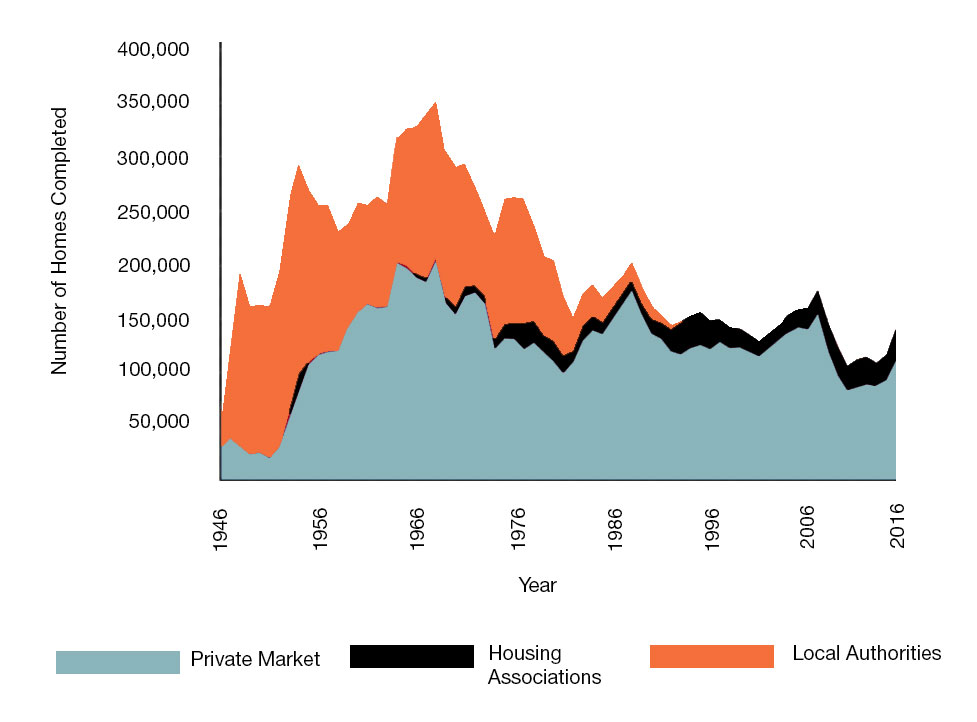
+ Diagram of Affordable Housing Delivery Since the 1980's

The diagram above shows how new housing delivery shifted almost entirely to  private sector developers in the 1980’s leaving a large gap in affordable or social housing provision.

What triggers Affordable Housing contributions in a smaller development?

Local authorities have adopted differing thresholds and different criteria to trigger affordable housing contributions and to what extent the contributions should be applied.  Nationally the NPPF (National Planning Policy Framework) states the following:

Affordable housing should not be sought on residential schemes that are not major developments. Paragraph 63 of the 2018 NPP confirms the Affordable Housing threshold as 10 or less dwellings or a combined floor space of 1,000sqm, with an optional lower threshold of 5 or less dwellings in designated areas.

The paradox is that a glossary within in the revised NPPF states that major developments are designated to be 10 dwellings or more, or sites over 0.5 hectares in size.  This differs from the previous PPG guidance (which has yet to be updated).

So it would seem notionally that the threshold has dropped by one unit: AH is now at 10 dwellings rather than 11 and the 1,000sqm trigger has been replaced with a site size trigger of 0.5 hectares instead.

Some local authorities may apply the 10 unit, 1,000sq m threshold.  Others, however, may apply the threshold to 10 unit projects within revised policy guidelines.

Planning applications are considered by local authorities in line with the guidance contained within their own adopted Local Plan. Local Plans are based on policies set out in regional and national guidelines. The discrepancy arises when Local Plans do not comply with National Planning guidance and there has been a great deal of discussion and legal representation by councils and developers in order to challenge and clarify inconsistent policy.

How is this applied in London – The New London Plan 2019

Policy H2 of The New London Plan introduces a ‘presumption in favour of small housing developments’. Small sites are considered to be ones that deliver up to 25 homes, or are less than 0.25ha.

Policy H5 of the strategic plan targets 50 per cent of all new homes delivered across London to be affordable.

Policy H2 notes that London boroughs wishing to apply affordable housing requirements to sites capable of delivering ten units or fewer and which have a maximum combined gross floor space of no more than 1,000 sqm should only require this through a tariff approach to off-site contributions rather than seeking on-site contributions. Boroughs are strongly encouraged to provide the flexibility for payments to be collected prior to the occupation of development, rather than prior to commencement of development.  The New London Plan, however, does encourage London boroughs to set policies at the local level which require cash payments in-lieu from sites of ten units or less.

However there are inconsistencies in the way London boroughs are interpreting policy, e.g.

The London Borough of Islington notes that ‘Following the publication of the revised

NPPF (2018), it will continue to seek financial contributions towards the provision of affordable housing from minor applications involving the creation of net additional residential units in line with Core Strategy Policy CS12 Part G and as outlined in the Council’s Small Sites Affordable Housing SPD (2012)’.

Islington goes on to note that, Section 70 of the Town and Country Planning Act 1990 and Section 38 of the Planning and Compulsory Purchase Act 2004 both emphasise the primacy of the Development Plan in determining Planning Applications. Whilst the revised NPPF (2018) Paragraph 63 constitutes an important material consideration, it is the Council’s position that in the light of the unique circumstances of the borough and objectively assessed need for affordable housing, that NPPF Paragraph 63 does not outweigh or override Policy CS12 Part G and the requirement for minor applications (sub 10 residential units) to provide a financial contribution towards the provision of affordable housing elsewhere in the borough.

Clearly Islington’s position is not compatible with national or regional policy and is therefore vulnerable to legal challenge.

Looking at a local authority elsewhere in the United Kingdom, Taunton Dean Borough Council have adopted Policy CP4 (2014).  This aims to ensure that affordable housing is provided as integral to all development schemes which provide five or more net additional dwellings. The policy states that 25% of all new housing should be in the form of affordable units.

Takeaway Advice

The NPPF notes that planning applications should be front loaded in terms of design development, this means that the liability for affordable housing is agreed during the pre-application or planning development process rather than in the decision making process post-submission. The first action is to check the status of local authority policy outlined in the Local Plan, and whether the policy is compliant.

In order to make an assessment for an initial appraisal Douglas and King follow the procedures below:

1. Assess the Local Plan to check the specific requirement for Affordable Housing contributions
2. Determine whether the Local Plan is compliant with regional or national policy
3. Check the local SHMA and SHLAA
4. Review recent locally-based planning applications to evaluate how AH policy and contributions are being applied/have been applied to similar sites
5. An Affordable Housing Contribution strategy is then built into the project’s development appraisal.


At Douglas and King we do much more at the concept design and appraisal stage.


6. Douglas and King have contacts with Housing Associations and other housing providers and are in a position to discuss and negotiate on-site provision at an early appraisal stage
7. We work with a number of AH consultants to assist with the prediction and negotiation of a suitable off-site construction contribution
8. There are obvious variations and differing interpretations being adopted by local authorities toward their individual AH policy and we identify these
Legislation and policy is in a process of change and is therefore subject to differing interpretations.  We double-check policy at all levels
9. We evaluate the AH contribution carefully and take advice if necessary. Each development project should be assessed within the context of the particular local authority.

The Architect led teams must design in a realistic and relevant AH Contribution at the concept and appraisal stage.

A step change in tackling the housing crisis

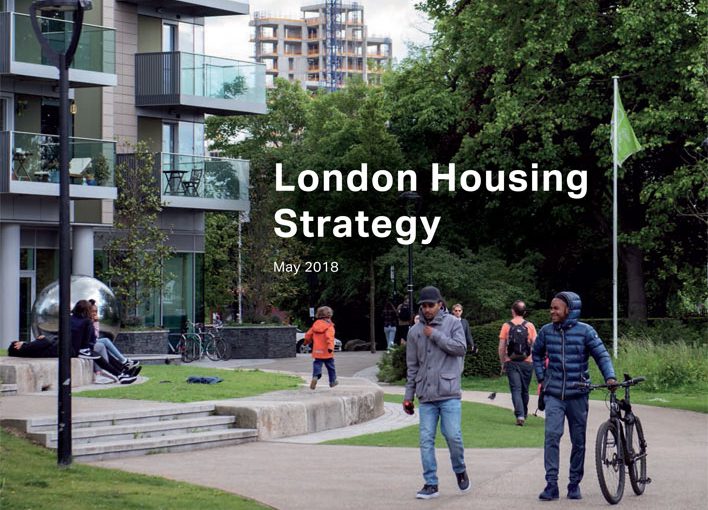
In May 2018 The Mayor of London published The London Housing Strategy which you can access here.

See our accompanying blogs:

“The Role of Small Sites in Achieving London’s Housing Delivery Targets”

and

“2017 Draft London Plan – An Architects View”.

In the next decade small sites, less than 0.25 hectares in size, will make a significant contribution to achieving The Mayor’s Housing Strategy.

SLHAA Assessments show that small sites, subject to revisions in local planning policy with a ‘Presumption in Favour of Development’ will represent 24,573 new home completions per year over 10 years.  These sites have historically been  classified as unsuitable for small-scale development under a Borough-wide policy which conversely favoured ‘Presumption Against Development Approval’

Below we include key points from the policy outlined in the document:

Mayor, Sadiq Khan, wants every Londoner to have access to a good quality home that meets their needs and at a price they can afford.

The strategy’s central priority is to build many more homes for Londoners – particularly genuinely affordable homes. The Mayor believes this is the only way to solve London’s housing crisis over the long term. Doing so will require action to unblock stalled housing sites and increase the speed of building. It will require steps to diversify who is building new homes, as well as where and how they are built and for whom. The Mayor is clear that he wants to meet our housing needs while protecting the Green Belt and open spaces. That means London must build at higher densities and ensure that all parts of the city host their fair share of new homes.

Homebuilding in London has become dominated by a relatively small number of large private sector developers who focus on building market sale homes. This model mainly builds homes that only a small segment of the population can afford and therefore it cannot support the kind of increase in delivery that we now require.

We need to boost different models, such as builders delivering purpose-built rented homes, more small-scale developments in outer London, and more delivery by housing associations. Sitting alongside this, the industry itself needs to be transformed, which means addressing the gap in construction skills and attracting more Londoners into a career in the construction industry.

Most important of all, we need to see more genuinely affordable homes built by the public sector. It has become clear across the post-war period, and it is truer than ever today, that London’s housing needs will not be met without concerted intervention by governments at all levels.

Municipal homebuilding provided nearly two-thirds of London’s new homes during the 1960s and 70s. Today, many local authorities have active council home-building programs, but they are severely limited in how far they can go by an array of top-down regulations and financial constraints.

Below, we set out the Borough by Borough targets that are to be achieved during the next decade from sites which have previously been viewed as unsuitable for small-scale development.

The Draft London Plan 2017 - Part H2 (Small Sites)

The London Mayor has stated that:

‘Over many decades, London has evolved, resulting in an extraordinary web of distinctive residential streets, squares, markets, parks, offices, and industrial and creative spaces. And the built environment we see today – the legacy of previous generations – has not just shaped the way our city looks, but has had a profound impact on how and where we live, work, study and socialise with one another.

Throughout this evolution, London has seen waves of growth and our surroundings reflect these past chapters of rapid development and change’.

Today our city is a rich environment endowed by the vision of previous generations. The historic street patterns, buildings and public spaces that survive today have done so because they were authentic representations of their time, admired and respected by successive generations of Londoners and continue to contribute to the uniqueness that is London.

Planning Policy in London will and must change in response to the Mayor’s aspiration to increase the built density required by London’s housing needs. The extent of the proposed changes in density will require Planners and Londoners to accept the fact that significant parts of their built environment will need to evolve in character and form in order to deliver the housing densification needed over the next decade.

We must as Londoners promote the concept of  ‘Good Growth‘ and the guidelines for its delivery as set out in The Mayor’s London Housing Strategy.