Sky space living

There has been a growing trend to maximise sky space living possibilities within the dense urban fabric of Central London where land values have appreciably risen and lower level spaces are largely given over to commercial and residential use.  In this blog we describe what we have learned from our experience of rooftop extension design.

Low-rise buildings of six to seven storeys through to high-rise buildings of sixteen to seventeen storeys, residential or otherwise used, are eminently suited to a rooftop implant.  These typologies can offer options for private residential apartment (s) or studio/office (s) or a combination of the two.

Rooftop developments are as functionally diverse as are those who commission them.  One might be a penthouse apartment to be lived in by the client, one might be a solicitor’s office for his/her personal use, one might be a residential development of five apartments to rent or a mixed development comprising two spacious apartments and studio/office space.

Douglas and King have completed several rooftop developments in Shoreditch – all in the Hackney Conservation Area. We completed the first one several years ago – it sits on the sky space of our old studio and one of our on-going projects now sits on the roof of our current studio.  Three of our current sky space projects have come to us from clients we had already worked with. New clients come to us simply because of our local and specific rooftop development expertise.

There are several ways to approach rooftop design – as a new build on a clean slate site, as an addition to the skyline as viewed from the street or as an addition to a host building.  We have found that a small difference to the context can result in a very different development approach.

Rooftop projects encourage designers and builders to sharpen their thinking and to work together from the early stages in order to produce a successful, efficient and cost-effective outcome.  There is little room for later design revisions or changes to the construction approach. The bonus for this early and close collaboration is that the project, once on site, tends to move faster as a result of the forward planning.
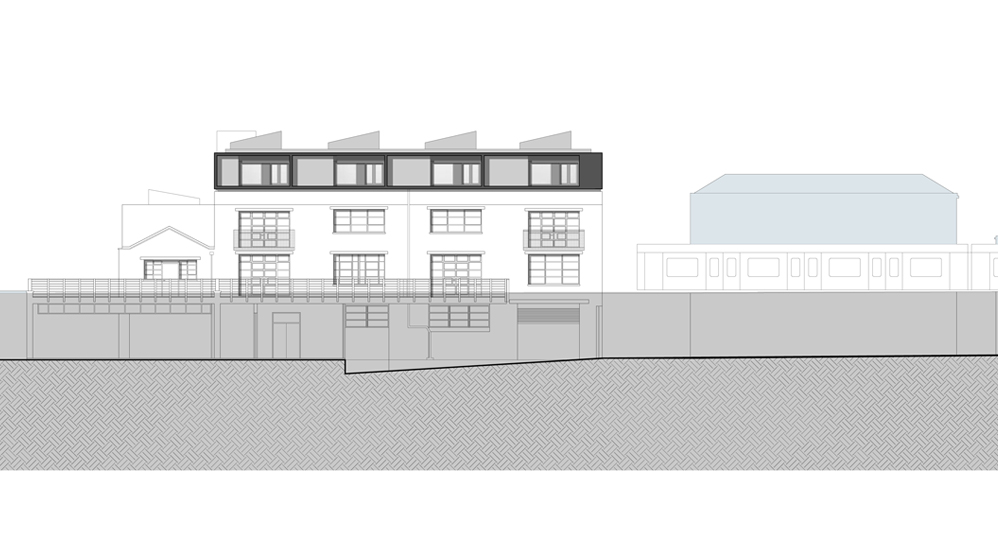
 

The design parameters are defined by the structure, access and services determined by the host building, its height and its immediate surroundings. The design has to be conceived with considerations such as scaffolding and access, disturbance to neighbours, noise levels, increased vehicular traffic, and the other unwelcome aspects of the construction process – each and every one of these should be addressed and minimised.  In some projects, to gain access for craning large elements onto the site has proved to be impossible.

For each project the design team evaluates the benefit of using prefabricated elements in order to minimise the construction timeframe, site access and working at height.

In general we find that the most workable solution is to erect a steel frame and construct exterior walls using glazed and cladded panels.   If the structure of the host building is irregular, then the structure of the extension will reflect the irregularity and accordingly it is easier to erect and complete on site.  We often design the proportions of the façade and glazing so that they interact with the grid positions determined by the host building below.

Sometimes traditional methods of construction can prove to be the most expedient option.

Designing with relatively traditional methods means that we can approach a wider range of contractors to gain broader expertise and competitive prices. We try to specify dry construction methods wherever possible, e.g. a steel frame with cladding that can be mechanically fixed. The skimming of plasterboard walls and ceilings, and the grouting of tiles are the only concession we try to make to wet trades.

Where possible building elements are prepared at ground level and hoisted or craned onto the construction platform in easy-to-handle chunks. We have found that working on rooftops ensures that the main contractor carefully considers the construction programme and process, the site set up and storage facilities– there is never enough room for working or storage at high level.

 Rooftop extensions involve working over someone else’s head, home or place of work. We have ourselves experienced one of our own projects being built over our heads so we know how disruptive it can be. The noise generated by work on a roof level travels down the building with alacrity, as does the fallout of dust and dirt and can be alarming to the residents below if they have not been made fully aware of potential side effects.  In advance of the construction phase we go to great lengths to ensure that the other building occupiers are conversant with the construction process, time frame, etc.

When designing at rooftop level it is tempting to prioritise the external views which are generally spectacular.  We have found that extensive glazing is inappropriate in domestic and small office environments as it results in a lack of privacy and contributes to a greenhouse effect.

The outdoor spaces associated with rooftop developments give endless possibilities for sculpture courts, exotic planting, fabulous views and, for star-gazers – an observatory of their own.
Who owns what?

The legal status in terms of ownership of a building or plot of land are critically important as a first step in assessing development potential.

Title Deeds are legal documents that record the details of ownership and any rights over a property in the UK. The documents detail the ownership status and any legal restrictions that may affect the status of a property. The title deeds for properties in England and Wales are held at Her Majesty’s Land Registry.

This blog provides a brief overview of what title deeds are, where to find them and what to look for and understand from the legal jargon which these documents inevitably employ.

The UK Land Registry

THE HM Land Registry was set up in 1862 and records the ownership rights of freehold properties and leasehold properties where the lease has been granted for a term exceeding seven years.

Today the title deeds documents can be easily accessed and retrieved online and are available to anyone who registers with the land registry website.

https://www.gov.uk/government/organisations/land-registry

Floor-Plan-998-x-700

Leasehold, Freehold or Commonhold

If a property is classified as freehold it means that the building is owned outright and in perpetuity. The owner’s name is identified on the title deeds as the Freeholder and Owner of the ‘Title Absolute’.

A freeholder is usually responsible for maintaining the common parts of a building such as the public areas and external walls and roof.   They are usually responsible for the Buildings Insurance but individual freeholder responsibilities may need to be determined and or clarified.

If a property is classified as leasehold this means that there is a lease in place that has been granted by the freeholder.  It is the temporary nature of leaseholds that sets leaseholds apart from freeholds.

The lease is a contract between a freeholder and a leaseholder that provides a temporary right to occupy land or property for a small annual fee.

For residential properties the contracts are often 90 or 100 years but there are many properties, particularly in London, with 999 year leases.

For commercial properties the specified lease period is anything from 5 to 25 years but with a number of rights to terminate the agreement on either side, usually denoted in the contract by a break clause.  Commercial leases are governed by the Landlord and Tennant Act 1954.

A third and increasingly more common form of ownership is called Commonhold. This occurs when a multi-occupancy building is divided into a number of freehold units, so each individual dwelling owns its own freehold.

The common parts of the building are owned by a management company which each dwelling within the building will own a share of, the size of which is proportional to the floor area of the dwelling against the overall area of the building.

The Title Deeds contain records of freeholds and leasehold contracts that may be in place and are submitted to the UK Land Registry by the conveyancing solicitor at the time of purchase or amendment(s) to a title.

Cables-in-Woods-998x754

Covenants, Easements and Wayleaves

The key things to look for are restrictions on a development that are imposed by agreement and highlighted within the title deeds.

Covenants

Covenants are usually included in the titles by the previous owners of the title and are binding to all future owners.  Some covenants are very old and can be bizarre in nature, some can be recent and have been executed by a previous owner.

Covenants can only be removed or ‘extinguished’ by agreement, a process that requires an application and a fee payment to the Lands Tribunal.  The Lands Tribunal is a civil court with jurisdiction over land and property, relating to title obligations, Right to Buy, compulsory purchase and other private rights.  This is the authority that can enable modifications to title deeds to be made.

The most common form of covenant that architects encounter is when a former owner, at the time of sale, imposes a restriction on the right of any future owner to create a development that includes, e.g. windows overlooking neighbouring properties.  It may also impose height restrictions on any part of a future development.

Covenants can be an obstacle to overcome but they do not necessarily prevent a development from taking place as they can be removed.  In complex covenant scenarios there are insurance policies available which will provide a developer the cover required against a covenant being enforced.

Easements

As with covenants, easements are recorded in the title deeds.  An easement is generally concerned with ‘rights of way’ and may grant rights to an adjoining owner (including utility companies) for access across parts or all of a piece of land.

Rights of way and other easements may be obtained through a history of usage, this is known as a ‘Prescriptive Easement’.

Applications for a Prescriptive Easement, i.e. if a right of way has been enjoyed for a specific amount of time, can be obtained by applying to the Land Registry.

There are exemptions to certain rights, in cases involving National Rail routes, Waterways or Crown Land.  These applications must be endorsed by the relevant Authority via a Statutory Declaration.

Redundant or out-dated easements can be removed by application to the Lands Tribunal.

Wayleaves

Wayleaves grant rights for utilities and services to pass over or under a piece of land or property and can be time limited or given in perpetuity.  They are generally granted in favour of statutory undertakers, the providers of utilities, e.g. Water, Gas or Electricity.  Wayleaves are normally identified within the Title Deeds.

Teacher-Stern-998x221

Specialist Advice

As architects it is important to have an understanding of what the Titles to a property are and the implications of their content.  We always check the content of title deeds with our legal partners, Teacher Stern Solicitors, who are experts in legislation and conveyancing.

Our contact there is Dov Katz d.katz@teacherstern.com

Don’t obstruct the light

Our original intention to explore how we design buildings for daylight in terms of design and in terms of the legal position of a right to daylight of neighbouring buildings. This piece was an attempt to unravel the legislation surrounding one of the oldest design dilemmas, the issue of ‘Rights to Light’ particularly in terms of side-by-side buildings in a dense urban context and separately how we as architects use daylight and orientation as one of the primary drivers in our design process.

After some reflection it seemed that it would be more informative, and enlightening (sic) to travel back in time and refer to the first treatise published on this subject by Vitruvius.

Vitruvius was a Roman author, architect, civil and military engineer during the 1st century BC and is best known for his multi-volume work entitled De architectura. His discussion of perfect proportion in architecture and the human body, led to the famous Renaissance drawing by Da Vinci of Vitruvian Man.

Early architects understood the importance of designing a building that was responsive to its position and orientation.  Vitruvius wrote as follows within his five fundamental principles of architecture:

 ‘There will also be a natural proprietary to use an eastern light for bedrooms and libraries, a western light in winter for baths and winter apartments, and a northern light for picture galleries and other places in which a steady light is needed; for that a quarter of the sky grows neither light nor dark with the course of the Sun, but remains steady and unshifting throughout the day’.

It would have been possible then (as it is now) to create models and measure their daylight performance over a given period of time in varying orientations.  This would have informed how the floor plan could best accommodate room arrangements and uses, both internal and external, window placement, etc.

Alongside these considerations other factors played a part – you’ve guessed – windows.

Glassmaking was already remarkably advanced during the Roman era, and many ancient homes had glass-paned windows. The earliest windows were panes of glassy pebbles laid on a wooden frame — these would let some light through, but probably weren’t that transparent. Clear glass panes were first invented in the late 3rd century CE, when glassmakers would blow a cylindrical bubble of glass and then slice it lengthwise and flatten out the results.

During the so-called Dark Ages, this technology, like so many others known before the Fall of Rome, somehow got lost. While cathedrals across Europe made use of stained glass for their windows, domestic windows were totally unglazed, with only wooden shutters to keep out the cold. Some people took thin animal hides (or parchment) and soaked them in oil to make them as translucent as possible. They also had to keep their windows (and doors) pretty small, to minimize the drafts, and whenever possible, curtains or mats further helped with insulation. This is why interiors were so dark back then, with the never-extinguished fire providing most of the light.

It was from the Renaissance onwards that architects were able to employ glazing as an integral architectural element and to exploit it in grand public structures.  The potential of double-height or enlarged ceiling heights enabled daylight to be reflected and distributed in innovative ways as it had been in the cathedrals of the Middle Ages.

Roof-lights, light-wells, enlarged and strategically located windows all contributed to the building’s response to its immediate environment and the natural progress of the sun throughout daylight hours.

In spite of the many overwhelmingly convincing arguments for natural light to be exploited as fully as possible within the domestic and working environments there are no guiding principles that indicate the relevance of designing ‘healthy’ buildings that respond to orientation and sunlight and impact as little as possible upon their immediate surroundings.

From take-away to tanning salons

  • A1 Shops – Shops, retail warehouses, hairdressers, undertakers, travel and ticket agencies, post offices, pet shops, sandwich bars, showrooms, domestic hire shops, dry cleaners, funeral directors and internet cafes.
  • A2 Financial and professional services – Financial services such as banks and building societies, professional services (other than health and medical services) and including estate and employment agencies. It does not include betting offices or pay day loan shops – these are now classed as “sui generis” uses (see below).
  • A3 Restaurants and cafés – For the sale of food and drink for consumption on the premises – restaurants, snack bars and cafes.
  • A4 Drinking establishments – Public houses, wine bars or other drinking establishments (but not night clubs).
  • A5 Hot food takeaways – For the sale of hot food for consumption off the premises.
  • AA Drinking establishments with expanded food provision 


  • B1 Business – Offices (other than those that fall within A2), research and development of products and processes, light industry appropriate in a residential area.
  • B2 General industrial – Use for industrial process other than one falling within class B1 (excluding incineration purposes, chemical treatment or landfill or hazardous waste).


  • C1 Hotels – Hotels, boarding and guest houses where no significant element of care is provided (excludes hostels).
  • C2 Residential institutions – Residential care homes, hospitals, nursing homes, boarding schools, residential colleges and training centres.
  • C2A Secure Residential Institution – Use for a provision of secure residential accommodation, including use as a prison, young offenders institution, detention centre, secure training centre, custody centre, short term holding centre, secure hospital, secure local authority accommodation or use as a military barracks.
  • C3 Dwellinghouses – this class is formed of 3 parts:
    • C3(a) covers use by a single person or a family (a couple whether married or not, a person related to one another with members of the family of one of the couple to be treated as members of the family of the other), an employer and certain domestic employees (such as an au pair, nanny, nurse, governess, servant, chauffeur, gardener, secretary and personal assistant), a carer and the person receiving the care and a foster parent and foster child.
    • C3(b): up to six people living together as a single household and receiving care e.g. supported housing schemes such as those for people with learning disabilities or mental health problems.
    • C3(c) allows for groups of people (up to six) living together as a single household. This allows for those groupings that do not fall within the C4 HMO definition, but which fell within the previous C3 use class, to be provided for i.e. a small religious community may fall into this section as could a homeowner who is living with a lodger.
  • C4 Houses in multiple occupation – small shared houses occupied by between three and six unrelated individuals, as their only or main residence, who share basic amenities such as a kitchen or bathroom.


  • D1 Non-residential institutions – Clinics, health centres, crèches, day nurseries, day centres, schools, art galleries (other than for sale or hire), museums, libraries, halls, places of worship, church halls, law court. Non residential education and training centres.
  • D2 Assembly and leisure – Cinemas, music and concert halls, bingo and dance halls (but not night clubs), swimming baths, skating rinks, gymnasiums or area for indoor or outdoor sports and recreations (except for motor sports, or where firearms are used).


  • Sui Generis

Certain uses do not fall within any use class and are considered ‘sui generis’. Such uses include: betting offices/shops, pay day loan shops, theatres, larger houses in multiple occupation, hostels providing no significant element of care, scrap yards. Petrol filling stations and shops selling and/or displaying motor vehicles. Retail warehouse clubs, nightclubs, launderettes, taxi businesses, amusement centres and casinos.