DAK Core Values

1. Beautiful Design

We don’t want to have to fight for beautiful architectural design. Or feel the need to champion quality and cheer-on the unique. We believe it should be a fundamental consideration for any project; but sadly it is not.

Architecture must, of course, be functional: for without function beautiful design is either art – or narcissism. Buildings need soul and beauty, yes. They should be interesting and inspiring: undoubtedly. But they must also be used. Visited. Worked-in. Lived-in. Appreciated. Valued. For a building must not just look right, it must feel right. It must be right.

This is what we want to create with you. We are not bean-counters who minimise living space to maximise profit. Your profit will come from appeal, not cramming: buildings that create attention, interest, desire. In our mass-produced word where houses are templates and offices are blocks it is the unique that catches the eye. The talented who push the boundaries. The passionate who create the future.

2. Respect

Architecture is about respect. We respect our client’s needs, wishes and desires. Respect the community – the people and the buildings – that live with and influence our work. Respect the environment on a small and a grand scale, aesthetically and materially. Respect history and the vernacular. Respect styles and opinions we may not yet have embraced – and respect those we choose not to.

3. Honesty & Integrity

Is there such a thing as a dishonest building? We think so. In fact, we know so. We design and build with honesty and integrity: buildings to be loved, not despised. Buildings that complement – even improve – their surroundings. Buildings that create conversation, not controversy. Buildings for people. Honest buildings with integrity.

4. A Demand For Quality

We don’t settle for second-best. We don’t shave a few pennies off a price at the expense of the attention to detail something as permanent, as prominent, as a building deserves. Quality design starts at the beginning and must continue unhindered throughout: we think, we talk, we brainstorm, we plan, we design, we model, we build. We demand quality.

Oranges and lemons: when I grow rich-say the bells of Shoreditch

Early Origins & Development

The name Shoreditch derives from the Saxon word ‘Soersditch’ as it was known, interpreted as ‘Sewer Ditch’, and thought to be a reference to the boggy watercourse of the river Walbrook which rose in the general direction of Curtain Road. Shoreditch originated at the junction of two important Roman roads that preceded the courses of Old Street and Kingsland Road.

Medieval Shoreditch was a paradox then as it is now – priories, convents and religious communities were founded here amongst it green open spaces and alongside traditional industries of that time such as brick making, tanning, ironmongery, saddling and tailoring.

By the 12th Century, the parish of St Leonard’s Shoreditch became established following the construction of the Church of St Leonard on the site of a previous church.

The historic narrative of Shoreditch runs through the market gardens that supplied medieval London and served the burgeoning population of Shoreditch and the City to London to the South. Shoreditch’s proximity to the City led to it becoming an early form of ‘suburb’ into which the overcrowded City spread.

Walbrook River Map

St Leonard’s Church

16th to 18th Century Development

Hoxton has been an area of entertainment and refreshment for centuries, located as it was on one of the main eastern thoroughfares into The City of London. During this period two of the first London theatres were built in Shoreditch, including Shakespeare’s Curtain Theatre built in 1576. It is said that Shakespeare’s first ever play was performed in Shoreditch.

In the late sixteenth century there were “enclosures for gardens, wherein are built many fair summer houses, some of them like midsummer pageants, with towers, turrets and chimney tops, not so much for use or profit, as for show and pleasure”.

Towards the end of the 17th Century and the beginning of the 18th Century a more residential and formal approach to town planning came into vogue. It was at this time that Hoxton Square was laid out in as an arrangement of terraced properties around a centralised garden space. Incidentally Hoxton comes from the Saxon word Hochestone, meaning a farm or fortified enclosure belonging to Hoch or Hocg.

Since 1140 there has been a church sat on the site of St Leonard’s at the northern end of Shoreditch High Street. The reconstruction of this church in 1736-40 encouraged the beginning of rapid growth and development in Shoreditch. The previous church had four aisles and a tower seventy feet high, with five bells. Those five bells are famous for the nursery rhyme “Oranges and Lemons: when I grow rich/say the bells of Shoreditch”. The Church was the first in London and probably in the country to be lit by gas in 1817.

From the 1770s, large areas of open land were beginning to be filled with a mixture of fragmented roads and formal developments. Many roads were lined with terrace houses, producing a street pattern that remains today.

The Original Site of Shakespeare’s Globe Theatre

Hoxton Square

St Leonard’s Church ‘Oranges and Lemons’ Sign

A mother and her daughters looking over the terraced housing in Shoreditch

19th to 20th Century Development

An unusual engraving of 1845 shows Shoreditch High Street with Georgian shopfronts inhabited by shops and trades of all descriptions. Early Victorian pubs and warehouses were beginning to be built. Trades included drapers, tailors, clothiers, mercers, boot and shoe makers, chemists, butchers, ironmongers, jewellers, oil and colour warehouses, etc. Shoreditch had become an important manufacturing area in the East End.

The quarter became industrialised in the 19th century with manufacturing centered around furniture making. It was during the late industrial period that Great Eastern Street was built, a main thoroughfare and a direct route from Old Street to Bishopsgate Goods Yard. With the decline of manufacturing in the 20th century the quarter became run down and semi-derelict however, furniture-making, clothing and printing were three trades that survived well into the early 21st century.

By the early 20th Century, Shoreditch was not a pleasant place to live, it was overcrowded and had the reputation of being unsafe. By the mid 20th Century the effects of two world wars resulted in a substantial loss of buildings: the population diminished and many trades moved north and east.

Book Market along Shoreditch High Street, 1930

Industrial Furniture Workshop in Shoreditch, 1959

Overcrowding, 1929

Today

Through the industrial and manufacturing eras of the 18th and 19th centuries, we arrive in the 21st century when Shoreditch is acknowledged to be London’s creative hub.

The first part of the 21st century has witnessed the advent of a successful design and conservation policy implemented by LB Hackney’s Planning Department. The Shoreditch Triangle is an area defined by Great Eastern Street, Shoreditch High Street and Old Street which now boasts some of the finest contemporary buildings that respond to the heritage and character of their neighbours.

These days the establishments that give Shoreditch a significant cultural status include the London College of Fashion, The Geffrye Museum, The Ace Hotel, Arnold Circus, Lena’s Store and The Strongroom to mention just a few – there are many others and more being conceived every day.

Shoreditch today represents one of the most successful inner-city regeneration/transition zones in Europe.  The design and digital industries within the City Fringe have created a significant Tech Hub and this coupled with the conversion of former warehouse and industrial buildings into social and artist live/work spaces has transformed the area into a must-see London destination.

Shoreditch Triangle bound by Old Street, Great Eastern Street and Shoreditch High Street

Image from London College of Fashion

Cafe in Shoreditch, Modern Society

Shoreditch Graffiti

Unlocking hidden value

This blog presents a snapshot of a research programme undertaken over the Summer of 2016 that looked into the relationship between the Architects desire to create beautiful buildings and the property developers brief to maximise investments. The programme was punctuated by a series of events and publications which included dialogue and input from our clients, consultants and partners.

As a design led office with a broad portfolio of successful projects we have proved that adding design quality to a project increases the value of a development.

The text and images in the blog below were part of a publication in the form of a mapfold titled Unlocking Hidden Value. Copies of the original A2 sized document can be downloaded from HERE

1-truss_492x375
2-finc_492x375
3-col_492x375
4-que_492x375

FINDING OPPORTUNITY

London is made up of a grid of unique plots that are repeatedly reconfigured and redeveloped — that is healthy urban regeneration. Each plot requires rigorous investigation in order to exploit the specific characteristics/constraints of the site.

Good design involves a detailed analysis of existing structures, immediate boundary issues, physical relationships, infrastructure and planning policy. A detailed understanding of locality in its widest sense is considered when seeking an ideal development scenario.

Adding value through a crafted design approach that will excite and win support locally and nationally, attracts prospective users and appeals to investors.

5-hasp_492x375
6-masi_492x375
7-finc_492x375-2
8-elmc_492x375

ADAPTING THE FABRIC

As the city expands and develops, many building typologies can be imaginatively and economically adapted to new uses and occupancy.

Working in and around redundant buildings and derelict structures presents a valuable opportunity to embrace their historic structures and elements. They can be bolted on to sensitively; equally they can be slotted into or extended within the context of well-crafted new buildings. Access and circulation routes are reimagined, lightwells inserted, basements excavated, galleried storeys introduced.

9-gleb2_492x375
10-material_492x375
11-col_492x375
12-php_492x375

PUSHING THE POTENTIAL

We believe that carefully considered design creates the highest quality buildings and achieves the maximum value for the site. Optimising development potential through our designs challenges the idea that the best returns are gained through maximising the number of apartments or squeezing the last square foot out of an office or retail unit. Working with private clients, developers and landowners, we bring these values to our projects, making each of them unique.

13-hasp_492x375
14-cur_492x375
15-all-saints_492x375
16-team_492x375

Practice News 2017

5th December 2017 – Planning Submitted for 90,000 sq ft Old Street Project

Our project to re-imagine a historic quarter of Shoreditch creating a new public space, 2 large commercial buildings and creating a small landmark building have been submitted for Planning following extensive design development within a Planning Performance Agreement with Hackney Council.

19th November 2017 – Construction of 3 New High-end Penthouses in Highgate Begins

Our plans to modify an existing mixed-use building and to add 3 new penthouse apartments has started on site along Archway Road. Planning was granted in January 2017 following successful negotiations with the local authority.

17th November 2017 – Camden Conservation Area Retrofit and Extension, Planning Submitted

Douglas and King have been developing designs for this sensitive site for a number of years. Planning has been submitted following extensive negotiations and reviews with the local Conservation Area Advisory Committee (CAAC).

31st October 2017 – Seven Sisters Road Mixed Use Awarded Planning

Islington Council has given the green light for our mixed-use development of apartments and workspaces.

5th October 2017 – North London House Submitted for Planning

One of several purpose-built private houses for individual clients currently in planning or under construction. Barnet 11 has been submitted for planning using the Council’s fast track planning process.

(20th December 2017 Update – Approved Subject to S106)

6th October 2017 – Planning for a New House in Wandsworth

This project creates a new dwelling on a narrow infill site in Wandsworth. Following negotiations planning has been submitted for this contemporary family home with a tiny footprint.

15th September 2017

Yet another excellent DAK member passes the Part 3 post, well done Mr Christopher Perry RIBA. As one of our favourite clients would say ‘let loose the dogs of war’ (From Julias Cesear)

1st September 2017 – Mid Century Building in Barnet to be Converted into a 21st Century School

Douglas and King are delighted to have been appointed as Architects to extend and covert a former synagogue into a primary school for the local Jewish Community.

14th September 2017 – Shoreditch Projects Widely Published

12th August 2017 – Designs Revealed for Greenwich Mixed Use Retro-Fit

The practice is working to secure planning permission that upgrades and extends a large listed building in the heart of Greenwich.

22nd July 2017 – Planning Approved for Croyden Apartments

Planning has been granted by Croydon Council to significantly refit and extend an existing apartment building. Construction is expected to commence on the 9 unit scheme in January 2018.

12th April 2017 – Finchley Road Apartment Building Starts on Site

The piling and groundworks for our £3.5m apartment development on Finchley Road in London is underway. The project is led by Douglas and King Architects as designers and Contract Administrators.

15th March 2017 – House in an Urban Woodland Starts on Site

One of several new-build family homes we are designing on London backland sites to reflect the need for these sites to be re-appraised as suitable for small dwellings. Occupancy should take place in early 2018. Click here for the design story.

10th February 2017 – Crossrail Apartments in West London

The practice are working on multiple residential developments along the route of the new Crossrail, Elizabeth Line. This particular project is for a private landowner who wished to develop three separate units of apartments in Hillingdon. Construction is expected to start in early 2018.

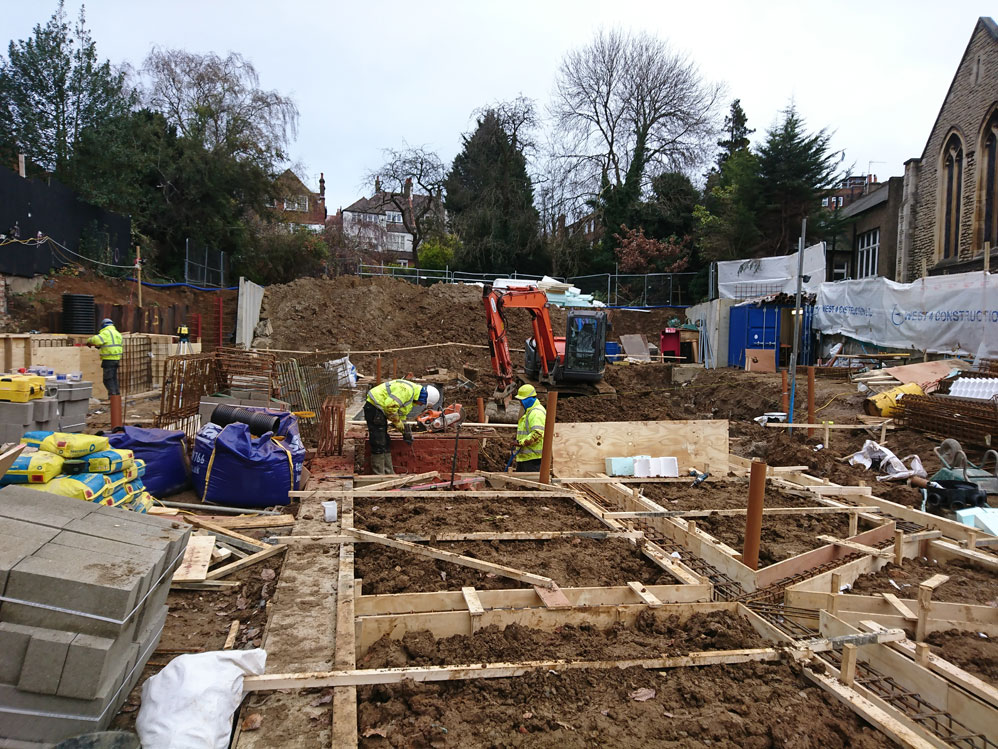
1st February 2017 – Contemporary Working Community created in Historic Hackney Warehouse

Our project to create 14,000 sq ft of mixed use commercial space in Hackney Wick has been completed and the project is now fully occupied. More Details on this highly efficient commercial building can be found by Clicking Here.

Mayor of London sets out strategic growth plan

What is the Draft London Plan?

The London Plan is a strategic plan issued by the Mayor of London that sets out a policy framework for the future development and sustainable, inclusive growth of the capital.

It sets out housing targets for individual London boroughs and encourages the development of small sites to boost overall housing delivery and stipulates material considerations designed to influence planning policies borough-wide.

Whilst the 2016 Consolidation Plan is still the adopted Development Plan, in November 2017 the Mayor published an updated version of the Plan for consultation purposes with revised strategic targets for new home deliveries across Inner and Outer London.

In this blog we give a brief synopsis and commentary on how this may affect those of our clients who are within the Landowning, Development and Private Client sectors.

Timeline

The timeline for adaption is as follows:

Key Points

Key points of note within the plan are:

Strategic Housing Targets for adaption by 2028

– 64,935 new homes across London to be achieved per annum

– Significantly more homes within outer London Boroughs (ranging from 1200 to 2000 homes per annum)

Presumption in favour of small housing developments

– Small and medium sized developers to make a significant contribution to achieving housing targets

– No Affordable Housing requirement for developments of 10 homes or fewer (Note: Anticipating the possible resistance to this proposal from boroughs, the Draft Plan sets out precise housing targets for the delivery of homes on small sites specifically and breaks this down to borough level)

– Relaxation of lift core requirements in small developments above ground level

Delivery of Affordable Housing

– Affordable Homes target to become 50% in the long term with a minimum of 35% in the short term

Housing Mix Requirements

– Recommendation that prescriptive housing mixes be eliminated from borough development plans. This could result in housing mixes responding more readily to market conditions and demand

Design Quality

– A significant emphasis on design and ‘high quality design’ with increased architect involvement within the S106 planning mechanism

Car and Cycle Parking Provision

– Support for car-free developments (in line with the Mayor’s agenda to improve air quality)

– Increased provision of cycle parking spaces

Housing Targets By Borough

Total 10 year capacity:

Summing Up

We will be keeping our developer and landowner clients informed as the Draft Plan moves through the above stages and will continue to advise our close partners on the availability of viable development sites.

– Douglas and King are experts in the development of left over or backland sites across inner and outer London boroughs

– We address the specific influences and constraints of any particular or individual site

– We are effective in overcoming planning restraints and policies

– We deliver sustainable cost-effective mixed-use and residential projects of all sizes


The Current and Draft London Plan can be easily accessed from the links below:

Current London Plan

https://www.london.gov.uk/sites/default/files/the_london_plan_2016_jan_2017_fix.pdf

Draft London Plan

https://www.london.gov.uk/sites/default/files/new_london_plan_december_2017_web_version.pdf

Bansky and Noir pull punters into Shoreditch

We have witnessed at first hand the district’s transformation from an inner-city backwater to one of Europe’s most vibrant social, business and creative quarters. We love being here and champion the rich mix that the area offers.

It was the dereliction of the industrial landscape that set the scene for the first creative influx into Shoreditch. In the ‘70’s through to the ‘90’s the large post-industrial buildings, some in a derelict state, were colonised by individuals who were making their emergence on the countercultural scene developing in London in those decades.

The sprawling energy of the area mirrored their rejection of ‘formal’ art.  The cheap rent and availability of the area’s large lofty spaces encouraged them to set up studios for co-working, collaboration, etc and many continue to live and work in Shoreditch today.

Individual inhabitants of these decades included Damien Hurst, Alexander McQueen, Tracy Emin, Sam Taylor Wood and Gary Hume.  By the early 21st c the White Cube Gallery in Hoxton Square was hosting exhibitions by Gilbert and George, Donatella Versace and Kate Hudson.

Pioneering venues included the former Blue Note Club in Hoxton Square and the Strong Room recording studios on Curtain Road, the latter of which has always had an arts led agenda and the ceiling of the lower bar has a large canvas by the Punk Rock artist Jamie Reed.

It was not long before this countercultural trend spilled out onto the streets in the form of graffiti, wall art, music and ready-made sculpture. Significant works by Banksy and Noir can be passed by on the streets of Shoreditch – its public art gallery is open to all.

‘Let us Adore and Endure Each Other’ illustrates in every way the paradox that characterises Shoreditch. The spontaneity of its message and execution across the city of Philadelphia reflects perfectly every stage in the history and evolution of Shoreditch.

adore verb (LOVE)

to love someone very much, especially in a way that shows a lot of admiration or respect

OR to like something very much

endure verb (EXPERIENCE)
to suffer something difficult, unpleasant, or painful:

The area has embraced and endured change in every century of its history and these transformations have left indelible physical and cultural markers visible throughout its urban landscape, streetscapes, periods of decline and its eventual ascent.

The themes that run through the Shoreditch story are the street and public arts narrative of the area.

+-8-Noir-998x749

Creative Workspace Available

What’s this about?

We are very lucky to work from a beautiful warehouse studio on Curtain Road in Shoreditch. Although our businesses are constantly developing and growing we occasionally have desk space that we let to friends and collaborators.

The studio is light and bright, we have a shared kitchen and meeting area and the desks are very large.

Where?
Our studio is located on the top floor of a Victorian Warehouse. We are located bang smack in the middle of the Shoreditch creative hub, 5 minutes from Old Street Underground, Liverpool Street and the very excellent Shoreditch High Street Overground Station. The studio is in a unique location set back from Curtain Road and is secure and quiet.
 
Why?
Shoreditch is well known as a hub for incubating start ups and as an area for SMEs to thrive. We enjoy the varied atmosphere that other disciplines bring to the studio.

How?
We ask only for one months deposit and one months notice. We are happy to issue a license and do not charge VAT on the desks. The desks cost £500pcm. BT broadband is available and a number of lines exist into the studio if you wish to install your own (ideal if you are an IT / Web business – hang off our system whilst you settle in).

Who?
If you wish to view the space please contact Lucy Von Denman at DandK on 0207 613 1395

.

Where to Vitruvius …

Update Note: The Housing Design Handbook.

Since this Article was released in 2018 an excellent residential design guide has been published by David Lavitt and Jo MaCafferty titled the Residential Design Handbook. The notes below outline the hierarchy of policymakers and touch on the history of design standards, however, this excellent Design Guide sets out the aspirations of modern Architects in creating the highest quality homes and neighbourhoods.

As Architects, we strive for the best possible design solution for both our clients and also the users of the buildings we design. This means that we look at each project on an individual basis and respond with a clear understanding of physical, cultural and legislative constraints. For residential developments, the key government guidelines are contained within four principle layers of design guidance.

1. The National Planning Policy Framework, the NPPF.

This is a national policy structure and sets high level targets for provision of  things like residential construction targets, development in the country side, employment, community engagement and the pre app process etc along with the performance of local authorities and their relationship with developers.

2. The London Housing Design Guide 2010. 

The London Housing Design Guide provides a detailed set of guidelines and is drawn from the criterial set on in the strategic documents as outlined in 1 to 3 above.

3. Housing – Supplementary Planning Guidance 2016

The Mayors SPG was published in 2016 and is a strategic view of current planning policy and performance in London. This document is an update to the 2010 Document listed below.

4. Local Level SPG and Design Guides.

Each Local Authority issues Planning Guidance as part of their own core strategy documents. The guidance varies from council to council but all must acknowledge the greater strategic design criteria set by central and regional government.

Whilst we have a profound understanding of government guidance within the hierarchy outlined above it is the 2010 publication, The Mayors Housing Design Guide (4) along with the 2016 update SPG (3) that are most referenced for specific design standards.

The Evolution of Standards

Standards in Architectural Design for housing provision have been set for many centuries. The cultural expectations have been set out by numerous Intellectual’s, Architects and Artists throughout history. Three examples of standards that have been influential in the evolution of modernist culture are noted below, there are many more prominent works through history particularly from alternative cultural backgrounds.

2-Vitruvius-499x725

De Architectura – The Ten Books on Architecture (30 – 15 BC)

The Roman Architect Vitruvius published De Architectura almost exactly 2000 years ago. The treatise provides a wealth of information on the layout, technology and materials of buildings and structures for developers in antiquity.

Within book 3 Vitruvius studies human proportions and the relationship of human form with the built environment. Book 6 sets guidelines for private houses with information on response to climate and context, symmetry and proportions, exposure and type and goes on to look at good construction practice with particular notes on foundations and sub-structures.

Leonardo Da Vinci’s Vitruvian Man (c.1490)

Leonardo’s work demonstrates the blend of mathematics and art during the Renaissance. The work clearly illustrates the earlier De Architectura with Leonardo’s own measurements of human bodies. Leonard’s Vitruvian Man depicts a man in two superimposed positions and is sometimes called the ‘Canon of Proportions’.

It was Vitruvius that proposed that the human figure was the principal source of proportion used in classical orders of Architecture. Leornardo’s drawing was an investigation into the relationship of human form and the built environment.

The Modulor and Modulor 2 (c.1948)

The French Architect Corbusier published The Modulor in 1948 followed by Modulor 2 in 1954. The books profile an investigation that attempts to find understand the complex issues surrounding human form. The Modulor is a sequence of measurements which Le Corbusier used to achieve harmony within architectural compositions. The Modulor was intended as a universal system of proportions.

Integrating design and construction

Membership of the RIBA is recognised the world over as a symbol of professional excellence among both clients and architects. Founded in 1834, and awarded its Royal Charter in 1837, the Royal Institute of British Architects (RIBA) is the UK charter body for architecture. Its mission is to advance architecture by demonstrating benefit to society and promoting excellence in the profession.

The RIBA publish guidelines in the appointment of an Architect and publishes standard appointment documentation, these are know as the Standard Agreement for the Appointment of an Architect.

The RIBA Plan of Work sets the industry standard for structuring a development project. The RIBA Plan of Work includes an online interactive model that may be downloaded and modified to suit the unique requirements of a particular project.

More information on the plan of work can be found on the RIBA website by CLICKING HERE.

A minor complication is that the Architects Appointment or Standard Form of Agreement for the Appointment of an Architect references the previous edition of the Plan of Work, the former addition is structured quite differently. Below we summarise how the current and former Plans compare as a quick reference in order that projects can be properly tracked during the transitional period.


The integrated project team

Working with Douglas and King you will talk to Martin regularly, you will also speak to one of the other assistants, including Annie who looks after our studio payments and invoicing. With Douglas and King you will also meet some of the Londons leading Engineers, Planners, Surveyors, Designers and Property Agents.

This page lists some of the network of people we have had the pleasure to build strong bonds with and who we have no hesitation in recommending to our clients. Click on an image to review their websites.

fm
gardiner-and-theobald
hardman-strustural-engineers
flatt-consulting
anstey-horne
wyg
jonathan-cook-landscape-architects-jcla
jll
stirling-ackroyd
john-d-wood-co
currell