An urban artifact for a key vista

An urban artifact for a key vista

Architect and Project Manager – Douglas and King Architects
Quantity Surveyor – Andrew Morton Associates
Clients Agent – John D Wood
Planning Consultant – BNP Paribas
Structural Engineer – Conisbee
MandE Engineers – Flatt
Agent – Stirling Ackroyd

Planning was granted for a proposed community resource building in 2020 following a design programme punctuated by series of pre app and community consultations led by the Architect. Design Management of a large team of consultants was fully managed by the Architect.

The plot is a void in the urban fabric, a vacant site on the main route between Islington and Hackney. The redundant site is at the end of a number of key vistas, on the boundary of two city boroughs, borders a well-known conservation area and is at the junction between two public places. To the East is the Tabernacle Square, a key public space on the route between Old Street Roundabout and the Shoreditch Triangle Conservation Area.

To the East is Tabernacle Square, an urban artefact on the route between Old Street Roundabout and the Shoreditch Triangle Conservation Area. To the North, the site forms part of the Shoreditch Gateway urban space, a public space that is defined by the new Art ‘Otel, the Shoreditch House residential tower and the new 10-storey Picture House that is part of our masterplan proposal for the route between Old Street Roundabout and the Shoreditch Triangle Conservation Area.

A contemporary response draws on the proportions of the historic terraces that neighbour the corner plot. Minimal detailing is balanced against a careful attention to texture and simple form to create a sculpted building that is a symbol of the maturity of Shoreditch.

Having successfully met the aspirations of our clients and of Hackney Council this project has been taken forward by another team who have redesigned the building for residential use.

The design team and delivery of this planning approval was led by Douglas and King Architects. For information on our processes read our blog on creative leadershio by CLICKING HERE

Corner-Plot-Day-Render_998x691
Public-space-elevations_998x977
3D_998x730
Townhouses-front-elev_998x286
6-Banksy-Shoreditch-998x643

How to put place-making at the core of a new community

How to Put Place-making at the core of a new community

Architect and Project Manager – Douglas and King Architects

Planning Consultant – Countrywide
Structural Engineer – TBC
MandE – TBC

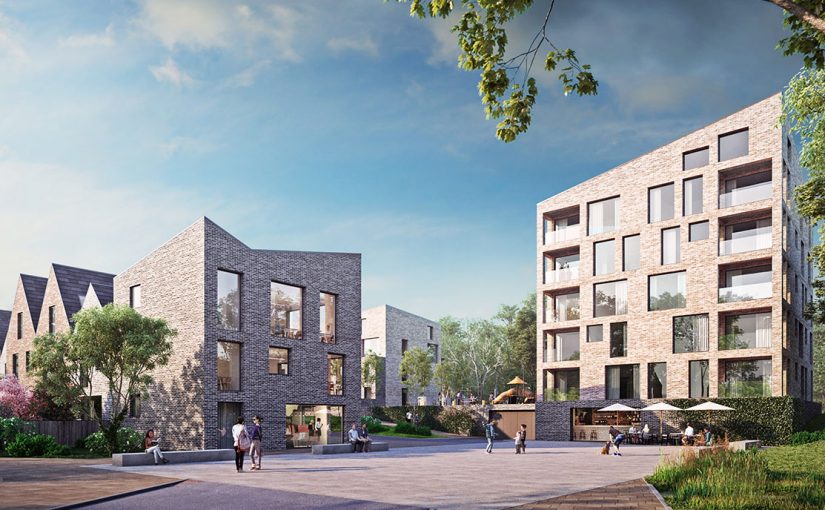
Douglas and King are working with house builders of all sizes throughout the United Kingdom. Our knowledge of creating great homes and successful communities with MMC Technology is helping private sector developers create highly sustainable and community focused projects.

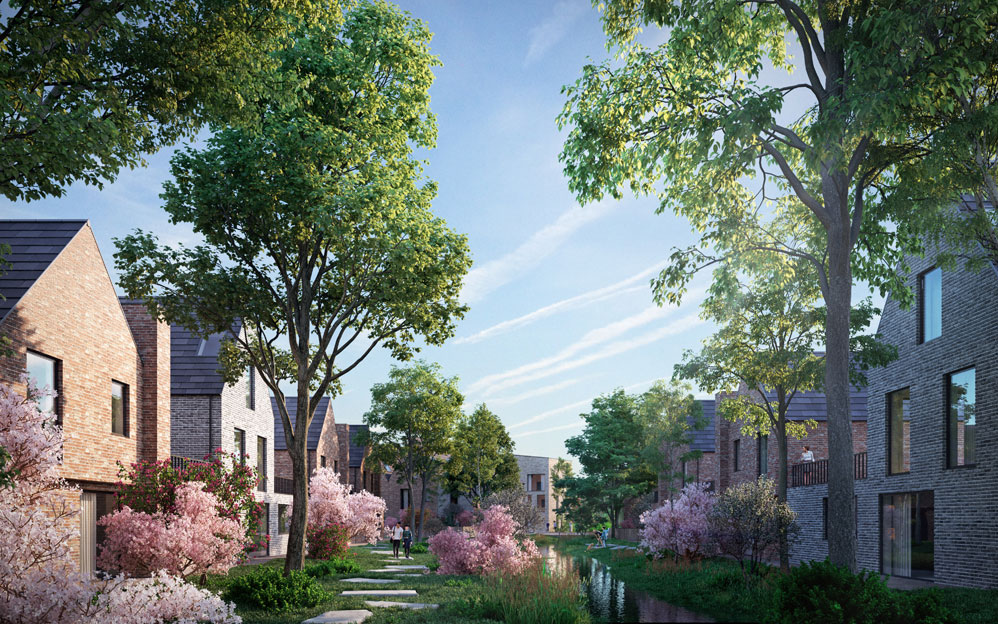
Our proposals aim to create a highly sustainable new neighbourhood on the western fringe of an existing New Town.  The design drivers follow the core principles set out in some of the most successful residential developments of the 21st century.

The site consists of an irregular shaped area of land that had not previously been developed and had the potential to offer a comprehensive development plot as part of a residential-led scheme.

The residential development comprises a total of 130+ homes in a mix of townhouses, mews houses and apartments located around a small communal square.  The range of home types and accommodation suits a broad spectrum of potential users and will attract an inclusive, diverse community.

A network of pedestrian routes has been carefully planned to provide connectivity to the neighbouring New Town, and these share equal parity with vehicular routes.

All streets are landscaped to engender the sense of a natural habitat, and play and public areas have been designed with community ‘policing’ in mind.  The shared access areas are planted with trees, shrubs and wild flowers.  Car parking locations have been sensitively situated throughout the development.

The design of the buildings is a contemporary response to the authentic, pre-industrial vernacular building forms of the area and uses a palette of materials that reflect this.

CHADs-Street-998x624

Sky living in the foothills of the city

Sky living in the foothills of the city

Architect and Project Manager – Douglas and King Architects
Planning Consultant – Douglas and King Architects

Structural Engineer – Fluid
MandE – Ingine
QS – Andrew Morton Associates

Douglas and King have a long history of maximising the development potential of existing buildings through design led development. This project from 2012 is one of many penthouses designed and built by the practice for private clients, for developers and for the owners of existing buildings.

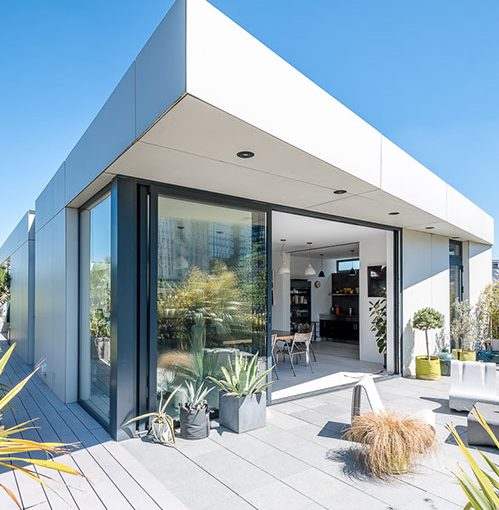
Douglas and King Architects designed the Shoreditch Penthouse extension for a private client/developer in the heart of Hackney. This project was featured in the Sunday Times, Bricks and Mortar magazine on 21st June 2019, the article can be viewed by clicking here!

The host building sits on a corner site in the heart of the South Shoreditch Conservation Area amidst Victorian warehouses and narrow surrounding streets.
The existing structure has two floors of commercial offices on the ground and first floors and apartments on the second and third floors.  It’s footprint and airspace offered our clients an ideal platform for erecting a new apartment at roof level providing a generous floor area of 208m sq and offering exceptional views of the City of London skyline.

Its external terraces circumnavigate the penthouse encouraging exotic and indigenous plant forms to flourish on the south and west facing aspects and provides an outdoor area for quiet enjoyment.
The penthouse combines intimate and social spaces within it’s glazed and solid cladded facades, and internal sliding partitions enable these spaces to be separate or interconnected.  A double set of sliding partitions enables the kitchen to be fully concealed or linked to the dining area.
Recessed roof lights allow natural light to flood through the apartment by day and at night the constellations of the stars are visible.

The proportions of the façade and full-height glazing interact with the grid positions determined by the host building.

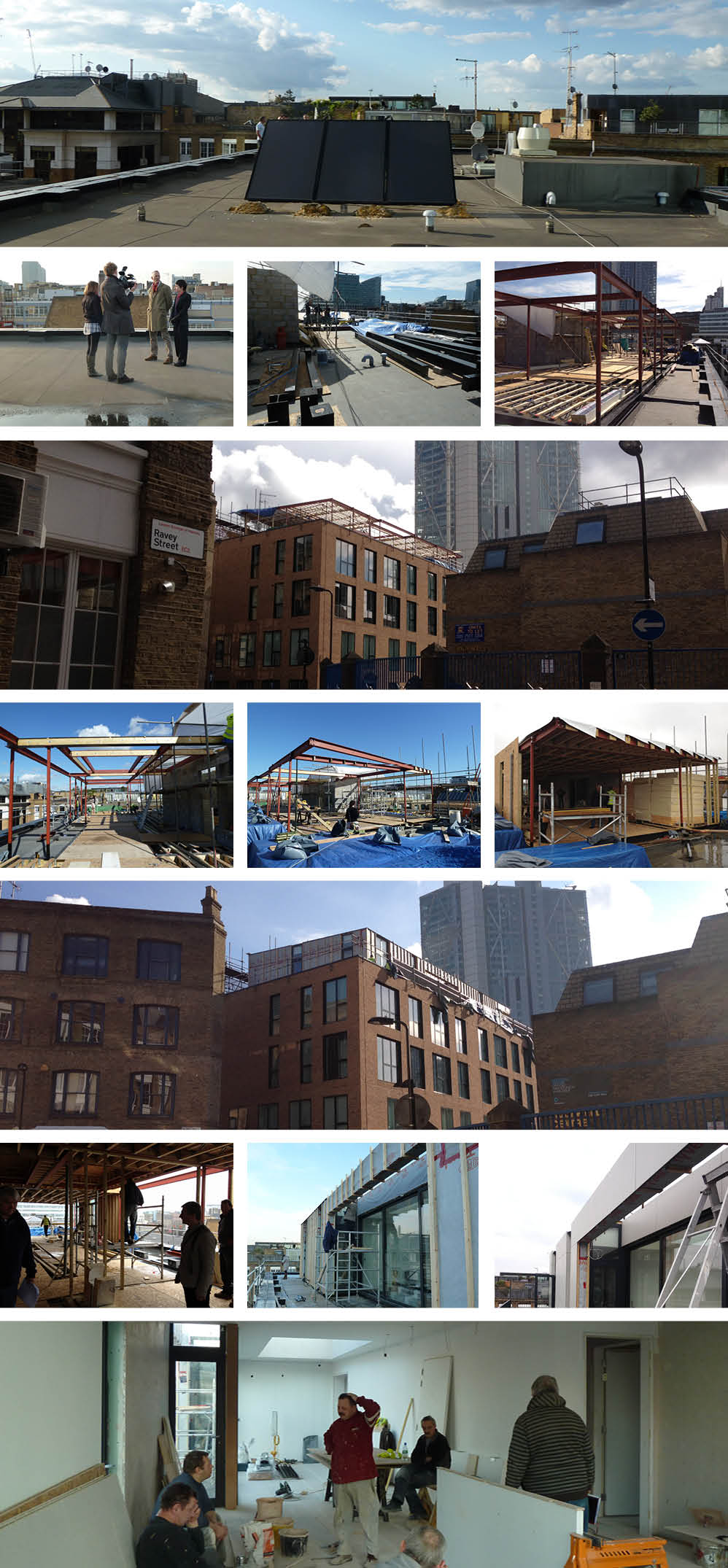
A Construction Story 2011 –  2012

Creating micro communities on urban backlands

Creating micro communities on urban backlands

Architect and Project Manager – Douglas and King Architects

Planning Consultant – GF Planning

Tranport – EAS
Sustainability Consultant – PB Sustainability
Ecology Consultant  – TMA

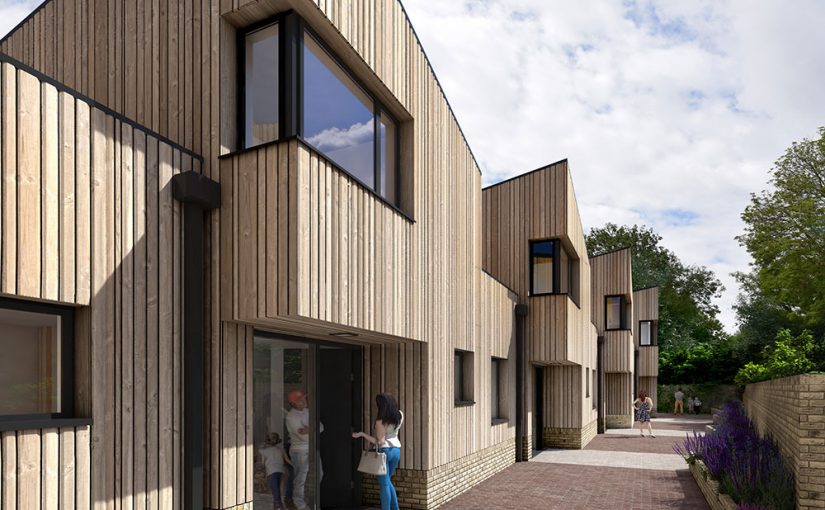
Douglas and King are currently working on numerous small sites throughout London and South East London in order to create high quality homes and communities on left over land within our urban fabric. We are leading the design for a small backland site in Forest Hill, South-east London, providing 5 high quality new homes in a sought after location. The development breaths new life into a under utilised brownfield site in an urban area, turning a service yard and storage garages, currently completely built over, into a desirable place to live. It is a car-free development, with numerous ecological advantages and the houses are highly energy efficient, creating a sustainable housing development.

The houses make use of the topography and orientation of the site, positioned carefully to reduce the impact on neighbours and surrounding trees. The entrance to the houses is on the mid level with the main living space on lower ground. A private courtyard is connected to the living space through a fully glazed wall with sliding doors, creating a strong link between the two and an external room.

The visual form of the houses is softened through the stepping of the terrace, first floor balconies, and softly pitched roofs. The massing of the terrace is broken down through the first floor breaks, splitting up the massing into smaller elements. Fragments of views and light are allowed, connecting the houses with the surrounding trees and landscape.

The houses use a brick lower floor with timber cladding above. The brick base ties the houses into the landscape, providing a strong footing and robust ground material. The timber cladding references the surrounding trees and other mews developments nearby. The combination of brick and timber is a traditional approach, but we have used it in a modern way through strong forms and clean detailing.

How natural contours can minimise visual impact

The natural contours can minimise visual impact

Architect and Project Manager – Douglas and King Architects
Planning Consultant – Douglas and King Architects
Structural Engineer – Conisbee
MandE – Mendick Waring

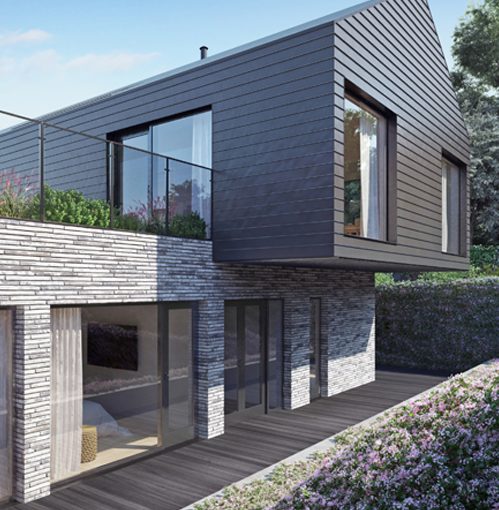
Hillside House is located on a south-facing hillside within a residential back-land site in Barnet.  The brief was to design a four-bedroom family house to the rear of the client’s existing home, with independent access and car/bicycle parking facilities, and to fully integrate the building into the topography of the site.

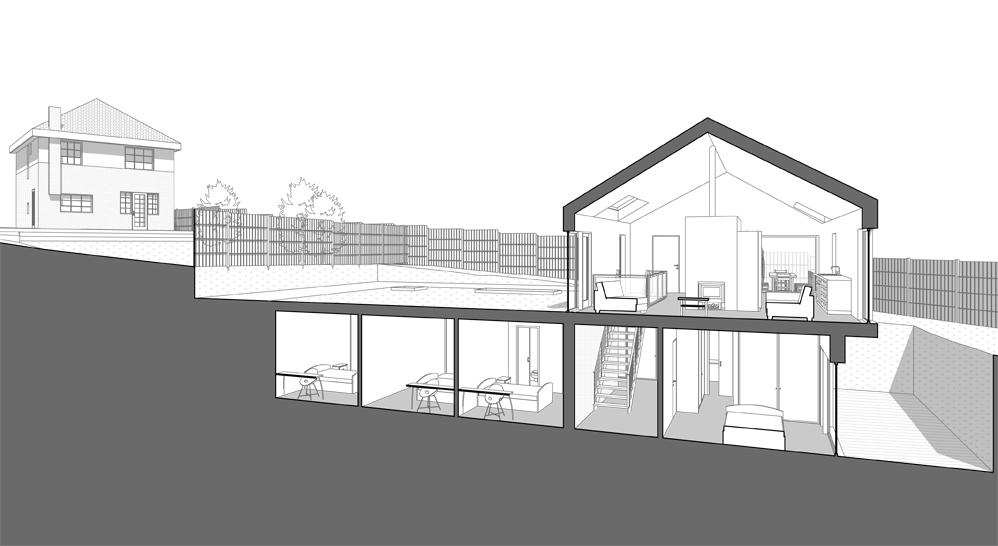
The ‘hillside’ concept sensitively adapts the configuration of the building to minimise its visual impact whilst maximising its privacy as a dwelling.  The partially submerged building eschews the traditional ‘house’ arrangement in order to allow the living areas on the upper floor to interact with light and nature at the existing garden level whilst the bedrooms and workspaces on the lower floor are sheltered and surrounded by a sunken-decked garden.

The building appears to have a single volume floating on and over the existing garden and could be construed to be a garden shed.  The open plan interior of the upper floor creates a perfect family/social space in contrast to the seclusion of the lower floor.

The site area is 750 sq m and the dwelling’s footprint is 177.5 sq m.  The building has been designed to be energy efficient through a cavity wall insulated system that provides high insulation during the winter.  During the summer it provides ventilation to prevent surface condensation.

Due to the energy-efficiency of the building shell it is possible to use a low temperature heating system such as under floor heating powered by a condensation boiler.

The green roof on top of the bedrooms area will provide an attenuation effect on the rainwater run off and the pitched roof allows for the installation of a solar PV Panel.

Planning Permission was granted at the beginning of February 2018 under delegated powers following a series of reviews with the LB Barnet and the tender and construction processes are taking place in 2018.

Douglas and King developed the project as designers and are acting for the client as Project Managers and Planning Consultants.  Our blog on Creative Project Leadership can be read by CLICKING HERE and our advice on developing Back-land Sites can be read in our Garden Grabbing Developments blog by CLICKING HERE 

A light-weight rooftop extension to a former warehouse

A light-weight rooftop extension to a former warehouse

Architect and Project Manager – Douglas and King Architects
Quantity Surveyor – Andrew Morton Associates
Planning Consultant – Douglas and King Architects
Structural Engineer – Fluid Structures
MandE – Ingine

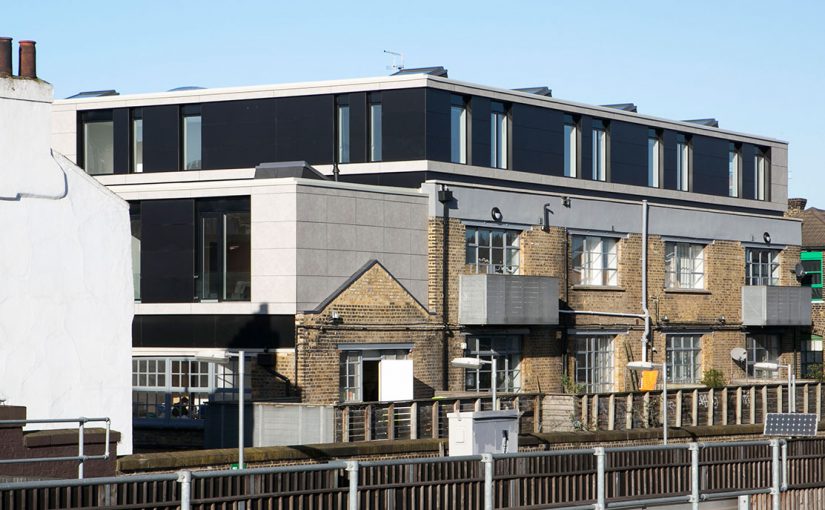
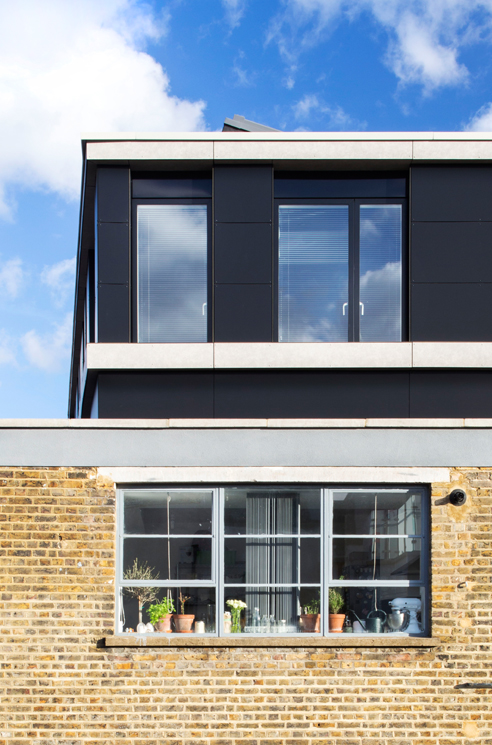
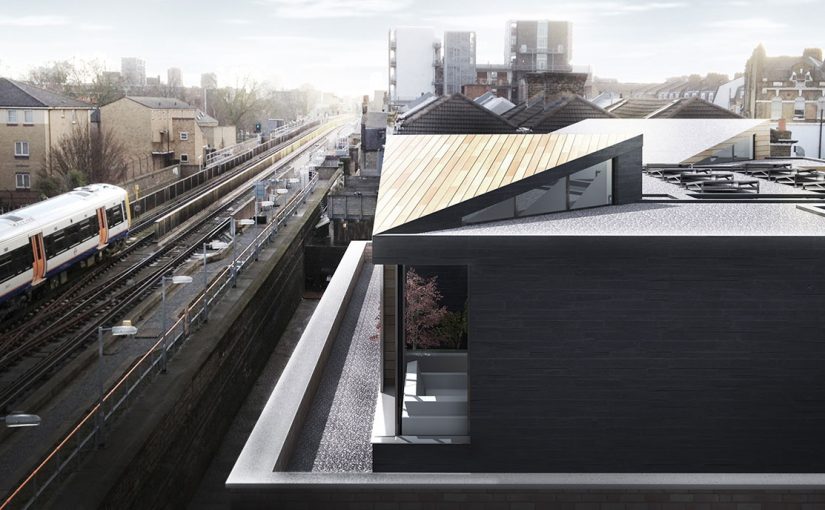
Within a former warehouse adjacent to Kingsland Viaduct 6 apartments were created from the existing building shell and 5 apartments created within a light-weight extension which floats above the existing historic structure.

The industrial feel of the building coupled with the ceiling volumes and generously proportioned geometric window spaces strongly suggested loft-style living spaces.

Metal louver panels articulate and control natural lighting to the building’s external envelope and irregular shaped roof lights disperse overhead natural light.

The design team and delivery of this project is led by Douglas and King Architects. For information on our processes read our blog on creative leadershio by CLICKING HERE

gleb-492px-interior
gleb-492px-stairjpg
gleb-998px-elevation
gleb-492px-kitchen

A modern response to a pre-existing building finds favour with planners

A modern response to a pre-existing building finds favour with planners

Architect and Project Manager – Douglas and King Architects

Planning Consultant – Stratagem
Daylight and Sunlight – Douglas and King Architects
Structural Engineer – Mason Navarro Partnership

Douglas and King have worked extensively in and around the historic building fabric of East London.  This project demonstrates how a pre-existing building can be extended to create contemporary new dwellings within a lightweight structure suspended above the historic lower structure.

It is also a good example of how a carefully designed modern response to an existing building will find favour with planners – it adds to the quality of a conservation area.

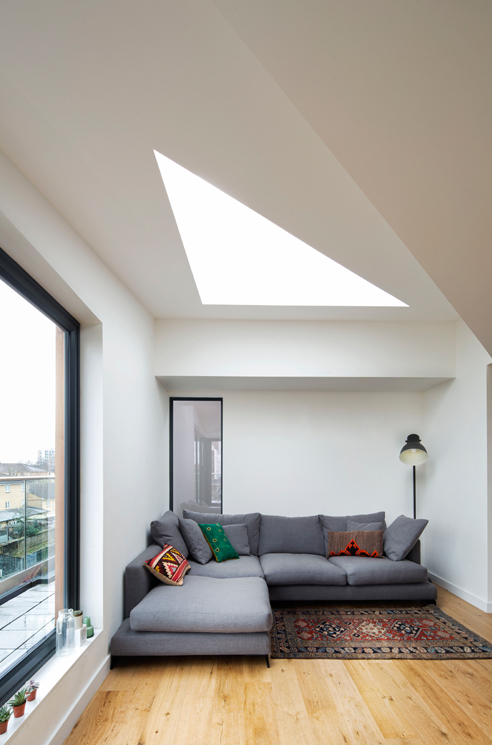
BIM software informed the layout of the new building and 3D modeling at an early stage and enabled us to minimize the impact of the building as viewed from street level.  It also influenced and maximized the benefit of daylight and restricted views, and respect of the rights to light of neighbouring properties.

Metallic cladding frames the large windows on the vertical aspects of the new rooftop apartments and glazed ceiling voids disperse natural light to those rooms where daylight needs to be maximised

gleb2-492x745px-living2
gleb2-492x745px-living

A triangle of place-making

Masterplan Shoreditch - A Triangle of Placemaking

Architect and Project Manager – Douglas and King Architects
Quantity Surveyor – Andrew Morton Associates
Clients Agent – John D Wood
Planning Consultant – BNP Paribas
Structural Engineer – Conisbee
MandE Engineers – Flatt
Agent – Sterling Ackroyd

MasterP-Cover-998x707

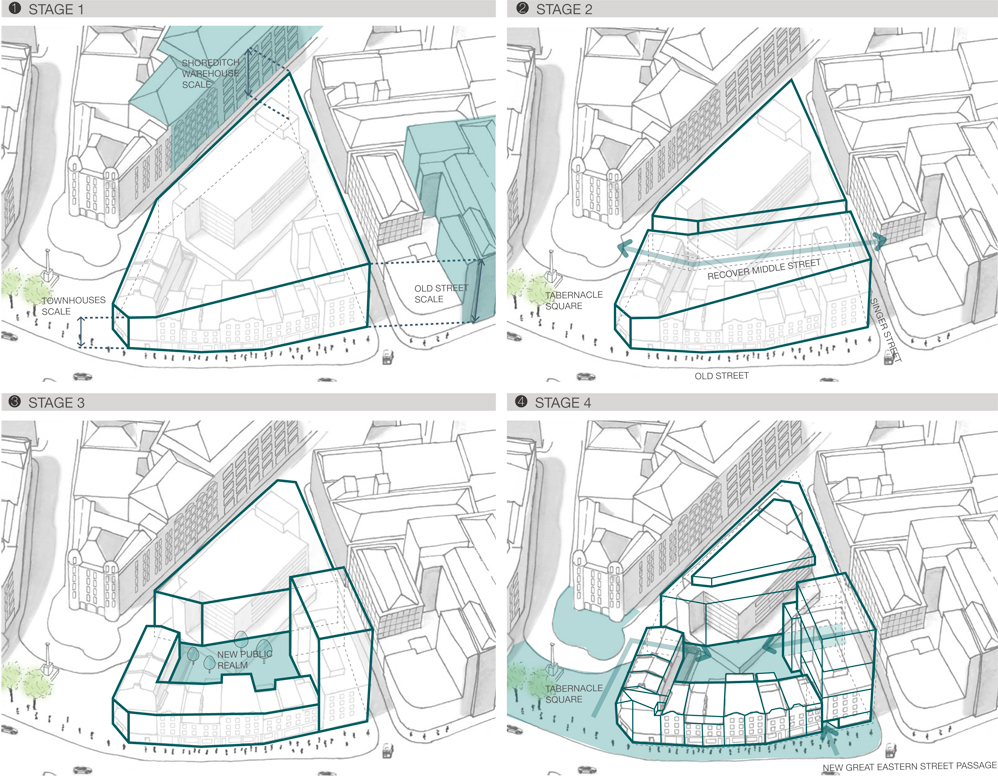
Douglas and King undertook the development of a Master Plan and Urban Design Framework for a triangular island site in Shoreditch, bordered by Great Eastern Street (north), Singer Street (west), and Tabernacle Street (south-east).

The proposal re-introduced an historic street, creating a new public piazza, re-imagining two 19th century terraces, designing three iconic new buildings which are responsive to their neighbours, and restoring a sense of place to a semi-derelict urban block within the South Shoreditch Conservation Area.

The masterplan drew upon the diversity, optimism, history, culture, and industrial heritage of this part of East London alongside the contemporary influences that now make Shoreditch one of the most successful urban regeneration programmes in Europe.

Shoreditch is an urban paradox that is both free-form and densely continuous:  it is now hosts one of London’s most creative hubs.   It is colourful, optimistic, characterful and its indigenous communities are a strong and vibrant part of this paradox.  Those communities have lived through a period of decline, neglect, traffic driven interventions and those challenges have left a deep-rooted sense of self determination amidst much uncertainty.

Our goals were to enhance the historic fabric of Shoreditch, to express through architecture and conservation the area’s rich history, to mirror the multiplicity of its inhabitants and to protect this Triangle from the commercial hub that is centred round the Old Street Roundabout.

Whilst this project was very sucessful and all the aspirations of the clients brief were fully met, changing market conditions have led to a new design team being appointed to take the project forward with a new brief.

The design team and delivery of this project was led by Douglas and King Architects. For information on our processes read our blog on creative leadershio by CLICKING HERE

OLDs-Location-998x723

Place-making The Triangle

The Triangle Master Plan will re-introduce an historic street, offer new vistas and a new public recreational space. It will restore a terrace of historic townhouses and provide 70,000 square feet of new workspace, retail, and commercial accommodation.  It will be characteristic of the local street boundaries and urban pattern and it will not be a private commercial development.  In keeping with the success of Shoreditch’s regeneration progamme achieved so far, the aspirations of Reitman Yard hinge on the inspiration of the entrepreneurial community that will work, visit, and grow within it’s environment.

How we are doing it

The primary ordering strategy is the shape of the site and the interface it forms between Tabernacle Square/Great Eastern Street, Singer Street and Old Street.  The secondary ordering strategy is the conservation and restoration of the existing historic terraces that form two sides of the Triangle.  The third is the demolition of derelict plots and the re-creation of lost legacies.  The fourth is a considered workplace strategy, and the fifth is the dialogue that the new architecture will have within the Triangle, with its immediate neighbours, and towards the urban character of the adjacent streets.


An open thoroughfare leading to and through a piazza will be at the heart of the development and is central to the intention that Reitman Yard lies wholly within the public realm.   This will also act as a foyer to the inner facades of the buildings and a restful traffic-free backwater to the busy pedestrian and traffic routes in the immediate area.  Contemporary landscaping will re-imagine St Agnes Well, and contribute moments of intensity and tranquillity.  A social space will be defined through the connectivity of cultivation, streetscape and atmosphere


The Physical Assets


The Triangle Master Plan will create a new 10-storey Picture House to the west of the site that acts as an ‘expressive marker’ along the route from Islington to Hackney. The Picture House is the tallest element of the development and our intention is to reflect the typologies of the proposed multi-storey Art ‘Otel, (occupying a focal position opposite Tabernacle Square) and Shoreditch House (a residential tower), on the junction of Great Eastern Street and Pitfield Street.


The existing Titchfield House will be demolished and replaced with a new contemporary building of five storeys that, height-wise, aligns itself with the existing roof levels. It will converse in it’s  21st century style with the architectural character of the 19th century industrial buildings along Singer Street and Tabernacle Street.


95 Tabernacle Street is currently a void in the urban fabric of the site and is the most visible aspect of the development as its corner position is a key local node on a principal point of intersection. An iconic galleried building informs the extension and re-imagining of the two adjacent terraces of townhouses. These are to be re-designed to create front to back shops, an architectural intervention that will provide glimpses through to the life of Reitman Yard.

MaterPlan-Courtyard-materials_998x1085a

What it will be like

The Triangle Master Plan confidently and consistently reflects the strategy of LB Hackney for the South Shoreditch Conservation area.  Each component or building can be designed individually in response to its immediate and neighbouring context.

The proposals for Picture House, Titchfield House and 95 Tabernacle Street are explained in more detail elsewhere on this website.